


- You are here:
-
Sights by Regions

-
Chornobyl Exclusion Zone
-
Pripyat
- Abandoned apartments, Pripyat

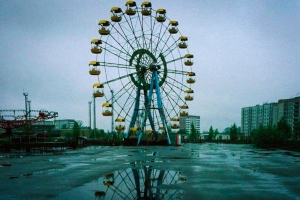


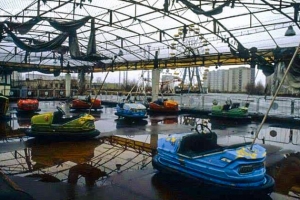
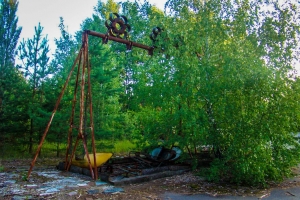


The world’s most famous amusement park never admitted a single official visitor. The yellow 26-metre Ferris wheel at the centre of Pripyat was installed in the spring of 1986. Its grand opening was set for May 1 — Soviet International Workers’ Day. Five days before the launch, Reactor No. 4 of the ChNPP exploded.
The park stayed «ready» but never «open». Today its yellow wheel, the row of yellow-and-blue bumper cars, and the swing-boats stand as the single most recognisable image of the Exclusion Zone — recognised even by people who have never set foot in Ukraine.
Location card
| Location | Pripyat city, behind the Enerhetyk Palace of Culture (city centre), ChNPP Exclusion Zone |
| Planned opening date | 1 May 1986 |
| Ferris wheel height | ~26 m, 16 yellow gondolas |
| Rides | Ferris wheel, bumper cars, swing-boat carousel, swing-boats, shooting gallery, arcade machines |
| Radiation level | among the highest in Pripyat (especially the moss around the bumper cars) |
| Access | official tours only; currently restricted due to the war |
| Time on site | 20–40 minutes (usually part of a full-day tour) |
| What to bring | respirator mandatory, closed shoes, charged camera, dosimeter (it will beep here) |
In this article
- What this park is and why it is unique
- Rides: full list
- History: the park that never opened
- Did they really spin the wheel on 27 April 1986?
- Why the park is the most contaminated spot in Pripyat
- Legends and ghost stories
- The park in popular culture
- What to see on site
- Today: war, occupation, and risks
- How to get there
- Traveller’s checklist
- Frequently asked questions
What this park is and why it is unique
The Pripyat City Park of Culture and Recreation was conceived as a gift for May Day. In 1986 the city was turning 16, the ChNPP was running steadily on four reactors, the population was approaching 50,000. Almost a quarter of them were children. Soviet logic demanded it: the atomic city of the future must have an amusement park with everything that entails.
And it was ready. The wheel had been installed and tested. Bumper cars, a carousel, swing-boats, a shooting gallery, arcade machines with stuffed-toy prizes — all of it waiting for 1 May. Local families were already debating which ride to take their children on first.
Not a single attraction ever operated in normal service. That is what makes the Pripyat amusement park unique: it is the only park in the world that was abandoned before it ever opened. Not a park that ran for 30 years and then closed. Not one that went bankrupt. A park that was fully assembled but never switched on.
Today it is a mandatory stop on any Pripyat tour. People come here to:
- photograph the yellow wheel — the defining image of the entire Exclusion Zone;
- see the bumper cars that never bumped;
- hear the dosimeter sing in the moss around the bumper cars;
- feel the harshest contrast in all of Pripyat — between intention and reality.
Rides: full list
The park was compact but fully equipped according to every canon of a Soviet «park of culture and rest».
Ferris wheel. The centrepiece. 26 metres tall, 16 bright-yellow gondolas with white arches. An ordinary mid-sized wheel for a district park, yet after 1986 it became the symbol of an entire era. The wheel had a central motor; it could only be operated by an attendant in the control cabin at the base.
Bumper cars (autodrome). A large covered arena with 12–15 cars, each fitted with a pole pick-up connected to the power grid through a metal mesh above. The cars were parked neatly in rows — and there they remain to this day, rusted and blanketed in moss.
Swing-boat carousel. A small children’s carousel with boat-shaped gondolas. Built for pre-school and early-school-age children. Today it is one of the most photogenic details in the park, thanks to the colourful boats.
Swing-boats («Flying Dutchman»). Large suspended boats in which two people would sit and rock — a classic Soviet fairground ride.
Shooting gallery and arcade machines. A small building with a pneumatic shooting range and arcade games. Stuffed-toy prizes and bags of sweets were given out here.
«Ice Cream» café. A light pavilion nearby where fizzy drinks, ice cream, and cakes were to be sold. In 1986 — fully stocked and ready.
Everything was purchased, delivered, installed, and tested. All that was missing was five days until the official opening.
History: the park that never opened
Winter–spring 1986: assembly
The rides were ordered and delivered to Pripyat over the winter and spring of 1986. By mid-April all the equipment was on site: the wheel assembled, the bumper cars in position, electrical networks connected, operators briefed. All that remained was to wait for the grand opening date.
Soviet cities loved big dates. May 1 in the USSR was one of the main state holidays: rallies, flags, concerts in the square, a peaceful family day. It was the natural date for a funfair launch. Pripyat prepared thoroughly: a script, performers from the Enerhetyk Palace of Culture, strings of lights.
26 April 1986: the explosion
At 1:23 a.m. Reactor No. 4 exploded. Thirteen hours later rumours of «something at the plant» began to spread through the city, but no official warning was issued. Schools and kindergartens operated normally that Saturday. Children played in the courtyards. The amusement park was five days from opening.
27 April 1986: evacuation
At 2:00 p.m. on 27 April evacuation was officially announced. Around 1,100 buses removed all residents of Pripyat within hours. The amusement park was touched directly: it simply never reached May 1. The rides were left standing — uncovered, unbroken, waiting — like a stage set for a show cancelled on opening night.
After 1986: a park-museum
Over the following decades the park became one of the best-known points in the entire Zone. Photographs from the 2000s show the gondolas: first vivid yellow, then paint-peeling, graffitied, rusted. Some gondolas have fallen or been removed. The bumper cars are slowly «drowning» in moss and shrubs growing up through the arena floor.
Did they really spin the wheel on 27 April 1986?
One of the most popular legends about the park claims that on the morning of 27 April, before the official evacuation announcement, city authorities hastily opened the amusement park to distract residents from rumours about the disaster. A few hours of operation, a few dozen people taking rides, and then — evacuation.
Here is what the evidence actually shows.
There is no documentary proof. No official record of the rides operating on 27 April has been found. In the memoirs of Pripyat’s former residents the story is sometimes mentioned, sometimes denied — depending on who is telling it.
Individual eyewitnesses say the wheel did turn. Several former residents recalled seeing the gondolas moving on the morning of 27 April. Others insist it is a myth and the gondolas never moved at all.
The logical evidence is weak. Had city authorities genuinely decided to open the park, documents such as operator work orders, electricity receipts, and cashier instructions would have remained. None of these have been found.
The park that «may have run — for a few hours, for those who didn’t yet know». This version took hold precisely because it fits so perfectly into the broader story of Soviet deception surrounding Chornobyl. Whether it is true is another matter.
Most likely the legend grew from a real fact: the rides were indeed being tested in the days before the launch, and some residents may have seen the wheel turning slowly with no passengers. That is not «opening» — but it is a perfectly plausible source for future retellings.
Why the park is the most contaminated spot in Pripyat
The paradox: an open space under the sky, washed by regular rain, should have «cleaned itself» long ago. Yet the park — especially the bumper-car arena — is one of the most contaminated places in the entire city.
Moss concentrates radionuclides. The green-brown moss growing around the bumper cars and on their bodies acts like a sponge: it absorbs caesium-137 and strontium-90 from rainwater and soil and accumulates them over decades. Spot measurements taken directly on this moss routinely read tens of times above the city background level.
Metal traps dust. The yellow gondolas, the bumper-car bodies, the steel frames — all pitted with rust. Radioactive dust lodges in those micro-cavities and is not washed out by rain or wind.
Standing under the wheel raises your dose. Standing directly beneath the wheel puts you closer to the metal. Stand on the open plaza 10 metres away and the reading drops considerably. Standard guide advice: approach, but don’t linger in one spot.
Do not sit, touch, or rest belongings. Placing a rucksack, phone, or camera on any ride surface is not advisable — even wiping it down with alcohol afterwards will not remove all radionuclides. A respirator is mandatory precisely here: this is where the dust is dirtiest.
Legends and ghost stories
A place this iconic accumulates legends. Some have a real kernel; others are pure folklore.
1. The wheel that turns by itself
Stalkers reported hearing the wheel creak in the middle of the night. The rational explanation is wind: 26 metres of metal framework with sixteen gondola-sails easily catches even a light breeze and rotates the axle by a degree or two. This produces the characteristic creak that is easy to interpret as something «supernatural».
2. «Children’s laughter» on the plaza
A canonical stalker campfire story: at a certain hour, laughter of children can be heard near the carousel. Vloggers have clips claiming to «capture» the sound, but it is almost always wind in the overgrown trees, or imagination at work. Psychologically powerful. Factually unproven.
3. «The boy in the yellow gondola»
A separate story circulates about a photograph of a boy supposedly sitting in one of the Ferris wheel gondolas. In different versions the child has different names and the photograph was «found» now in a stalker’s archive, now on a researcher’s computer. No version has ever been documented. Most likely — a Photoshop job or a trick of the light.
The park in popular culture
HBO’s Chernobyl (2019). The yellow wheel appears in one of the miniseries’ most powerful scenes — a static shot, no dialogue, just the wheel against a grey sky. That frame travelled across social media worldwide and reintroduced Pripyat to an entirely new generation.
S.T.A.L.K.E.R. The Ukrainian game series by GSC Game World placed the wheel in several locations where it became a symbol of «the Zone». Many gamers recognised the real object before they ever saw the original photograph.
Call of Duty 4: Modern Warfare. In the mission «All Ghillied Up» (2007) the player spots the wheel in the distance while moving through abandoned Pripyat — a rare instance of a real city’s history serving as the backdrop for a blockbuster game.
Documentaries and photo projects. The Pripyat amusement park is the world’s most photographed abandoned location. Its images appear in dozens of films from National Geographic to BBC, in articles from The Guardian and the NY Times, and in urbex photography books worldwide.
What to see on site
The park is compact — all rides occupy a single plot roughly the size of a football pitch. Here are the key points.
Ferris wheel, front view. The classic shooting angle — from the north side, looking at all 16 gondolas «facing» the camera. Best light is in poor weather: a grey sky behind the wheel gives the most dramatic frame.
Ferris wheel, looking up. Standing directly beneath the wheel and shooting upward gives an unusual perspective. Don’t linger too long: the radiation reading here is above average.
Bumper-car arena. A row of cars in various positions, several thickly furred with moss. The dosimeter almost always «twitches» here. Do not sit on the cars or touch them with bare hands.
Swing-boat carousel. A small children’s carousel nearby. Less photogenic than the wheel, but it carries one of the park’s most affecting visual metaphors.
Swing-boats. Two tall metal poles with suspended boats swaying quietly in the wind. A striking angle is to photograph them with the distant apartment blocks — overgrown with forest now — framed behind.
«Ice Cream» café. A small pavilion next to the park, its roof partially collapsed. Inside, the remains of the counter where fizzy drinks and sweets were to be served.
Today: war, occupation, and risks
In February 2022 the Exclusion Zone was temporarily occupied by Russian forces that entered from Belarusian territory. Pripyat found itself inside a zone of active combat. During the occupation, which lasted until the end of March, parts of the city were mined, partially looted, and certain buildings converted into Russian military posts. The amusement park, as one of the most exposed points in the city, was also subject to risks related to mining of the surrounding area.
As of 2026, tourist access to Pripyat — including the amusement park — is restricted. Occasional official visits are arranged by the State Agency of Ukraine for Exclusion Zone Management for journalists, scientific groups, and official delegations. The condition of the rides has deteriorated noticeably in recent years, partly because there has been no oversight whatsoever.
Before planning any trip, always check the current access status on the official SAEZM website and with licensed tour operators. Independent entry into the Zone is a criminal offence.
How to get there
By car (organised groups only): from Kyiv north along route P-02 through Ivankiv to the Dytyatky checkpoint. Distance — approximately 110 km, roughly 2 h 15 min. Private vehicles are not admitted beyond the checkpoint.
Tour from Kyiv: the only legal option for the ordinary traveller. Tour operators run coach or minibus departures from central Kyiv, providing permits, dosimeters, a safety briefing, and lunch. Trips are typically full-day. The amusement park is on virtually every Pripyat tour itinerary — visited right after the Enerhetyk Palace of Culture.
No public transport reaches Pripyat. It is a closed city inside the Zone; no scheduled bus services go there.
GPS coordinates of the park: 51.4066° N, 30.0573° E (central Pripyat, behind the Enerhetyk building).
Documents: international passport or national ID card, a permit application submitted at least 7 days in advance. Foreign nationals face the same requirements plus an additional form.
Traveller’s checklist
What to bring:
- International passport or ID card (you will not pass the checkpoint without one).
- Respirator or high-filtration mask — in the park this is not ambience, it is a necessity.
- Closed shoes with a thick sole (disposable shoe covers on top are a good idea).
- Long-sleeved clothing you are prepared to discard.
- Charged phone + power bank — you will take many shots.
- Dosimeter (optional) — this is exactly where it will perform most dramatically.
- Bottled water and snacks.
- Sunscreen — you will spend considerable time on an open plaza.
What NOT to do:
- Do not sit on the rides, touch them with bare hands, or rest belongings on their surfaces.
- Do not pull at the moss, lean over it, or take dosimeter readings from very close range without good reason.
- Do not eat or drink inside the park — it is the most contaminated point in the city.
- Do not fall behind the group.
- Do not climb into the Ferris wheel gondolas — they are structurally unsound and their fixings have not been maintained.
Frequently asked questions
Did the park really never officially open?
Correct. The grand opening was scheduled for 1 May 1986, but the explosion on 26 April and the evacuation on 27 April meant it was cancelled. Whether individual rides were operated on evacuation day is disputed, but the park never had its official opening.
Can you climb into a Ferris wheel gondola?
No. The gondolas are structurally compromised, the fixtures have not been maintained since 1986, and the metal framework is corroded in places. Any additional load is a risk. Guides strictly prohibit it.
What is the radiation level here?
It depends on exactly where you stand. On the open plaza in the middle of the park the reading is only marginally above Kyiv background. Directly over the moss around the bumper cars, readings routinely exceed the city background by tens of times. For a tourist wearing a respirator and spending limited time here, this is not a dangerous exposure — but it is the dirtiest single point in the entire city.
How many gondolas does the Ferris wheel have?
16 yellow gondolas with white arches. Some have collapsed or been removed over the years, so recent photographs may show fewer.
Can you visit the park right now?
As of 2026 — no. Tourist access to Pripyat is closed due to the war and the aftermath of the Russian occupation of the Zone in 2022. Limited visits are organised for journalists and scientific groups. Check the current status with the State Agency for Exclusion Zone Management before making any plans.
Did they really spin the wheel on 27 April 1986?
There is no documentary evidence. Some eyewitnesses say they saw the gondolas moving, but this may have been a technical test run with no passengers. Most likely the legend grew from exactly that — and survived because of the general atmosphere of concealment surrounding the disaster in its opening hours.
The Pripyat Amusement Park is not an «abandoned location» in the usual sense. It is a park that never lived a single ordinary day. A wheel meant to turn for the first time on 1 May 1986. Bumper cars that were supposed to collide on opening evening. A carousel that families with three-year-olds were looking forward to. A shooting gallery where stuffed toys were to be knocked off shelves.
None of it happened. And that absence of an ordinary park’s history is precisely what makes it the most powerful single symbol of the entire Chornobyl disaster. Other sites in the Zone had some life before 1986. The amusement park had none. It remained in a state of perpetual anticipation of a May Day that never came.
If you ever stand in front of that yellow wheel, remember it is not just a photograph for Instagram. It is the world’s most truthful illustration of what it means to put a life on pause — and forget to press play.
JoomShopping Download & Support