


- You are here:
-
Sights by Regions

-
Chornobyl Exclusion Zone
-
Pripyat
- Hotel Polissya, Pripyat

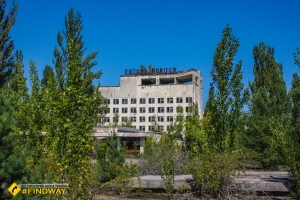

On 26 April 1986, soldiers stood on the roof of the eight-storey Hotel Polissia with binoculars. From this point, reactor No. 4 was clearly visible three kilometres away, burning. From this roof, the first helicopter drops of sand, lead and boric acid into the shattered heart of the Chernobyl Nuclear Power Plant were coordinated.
The hotel itself stood empty: guests had already left before the evacuation was ordered, and the desk clerk had locked the doors. But the rooftop suddenly proved to be the best observation post in the city. Within days, Polissia had transformed from a regional hotel for nuclear workers’ guests into the command centre of one of the largest technological disaster responses of the twentieth century.
Location Card
| Location | Pripyat, central square (former Lenin Square), ChNPP Exclusion Zone, Kyiv Oblast |
| Year opened | approximately 1975 |
| Storeys | 8 (some sources say 7) |
| Number of rooms | around 80 |
| Distinctive feature | the word «PRIPYAT» in raised letters on the main facade below the roofline |
| Access | official Exclusion Zone tours only; currently restricted due to the war |
| Time to explore | 30–50 minutes (typically part of a full-day city tour) |
| What to bring | respirator, sturdy closed footwear, torch, power bank, dosimeter (optional) |
In This Article
- What Is Hotel Polissia and Why Visitors Come
- Architecture and Interior Layout
- History: From Nuclear Workers’ Hotel to Abandoned Tower
- The Roof That Directed the Helicopters
- The Central Square: What’s Nearby
- Legends and Urban Stories
- Hotel Polissia in Popular Culture
- What to See on Site
- Today: War, Occupation and Damage
- Getting There
- Visitor Checklist
- Frequently Asked Questions
What Is Hotel Polissia and Why Visitors Come
Polissia was the main — and only — hotel in the Soviet nuclear city of Pripyat. Not a rural guesthouse or a resort lodge: a proper urban hotel with a restaurant, lobby, reception desk, lift and room stock, serving delegations, design engineers, deployed installation workers and senior guests of the Chernobyl Nuclear Power Plant.
Since 1986, it has also been one of the most recognisable buildings in the Exclusion Zone. The eight-storey concrete tower stands in the middle of the central square, and on its facade below the roofline, a large inscription still reads: «PRIPYAT.» Every documentary about Chernobyl shows this shot sooner or later.
Today Polissia is one of three essential stops on any Pripyat tour, alongside the Lazurny swimming pool and the fairground Ferris wheel. People come to:
- photograph the «PRIPYAT» inscription — the ghost city’s defining image;
- walk the central square of a Soviet city of the future that never arrived;
- see the very building whose roof was used to coordinate the first reactor drops;
- grasp the scale — what the centre of a city of 50,000 people looks like, frozen in April 1986.
Architecture and Interior Layout
Polissia is a textbook example of Soviet modernism from the mid-1970s. No columns, no ornamental trim — just the rhythm of concrete balcony slabs and glass. Hotels were built this way all across the USSR in those years, from Kaliningrad to Khabarovsk. That ubiquity is part of its power: standing in the lobby, you are simultaneously standing in dozens of other hotels remembered by anyone who ever travelled on a Soviet business trip.
Ground floor. Reception with a long desk, a spacious lobby with armchairs, a cloakroom and a restaurant with a buffet. The dining room looked directly out onto the main square — sit at a table and you were at the centre of the city.
Second through seventh floors. Guest rooms: single and double, standard Soviet specification. Around 80 rooms in total. Each floor had a floor attendant; keys were handed in to her.
Top (eighth) floor. Intended as a summer cafe with an open terrace and panoramic views over the square and city blocks. Some sources suggest it had not been fully opened for business by April 1986. Visitors who reach the upper floors today are rewarded with one of the finest views in the entire Exclusion Zone.
The facade inscription. The large raised letters «PRIPYAT» below the roofline are not advertising — they are a place-name marker, in keeping with Soviet practice for hotels in regional towns throughout the USSR. In Pripyat, these letters became the ghost city’s most recognisable brand.
A standard Soviet hotel in a decidedly non-standard Soviet city. It is precisely this familiar ordinariness that made Polissia the visual symbol of dead Pripyat.
History: From Nuclear Workers’ Hotel to Abandoned Tower
The 1970s: Construction and Opening
Pripyat was founded in 1970 as a satellite city for the future Chernobyl Nuclear Power Plant. The first reactor unit came online in 1977, and the construction boom at the station continued for decades. The city saw a constant flow of visitors: designers from Moscow, Leningrad and Kyiv, delegations from the «fraternal republics,» inspectors from the Ministry of Atomic Energy. A large, presentable hotel was needed — and so Polissia was born.
The building went up in the mid-1970s (most sources say around 1975) on the central square. The location was deliberate: the Palace of Culture «Enerhetyk,» the Raiduga department store and the city executive committee were all within 200 metres of the front desk.
Before 26 April 1986: An Ordinary City Hotel
For the next eleven years, Polissia ran at the pace of any Soviet regional hotel. Incoming delegations, open-day events for each new ChNPP reactor unit, engineering-team dinners in the restaurant, New Year trees in the lobby. Guest books survive with complaints about room temperatures and thanks for the restaurant lunch. Everything as everywhere.
April 1986: The Last Guests
The day before the disaster, the hotel was still issuing room keys. On 26 April 1986, in the hours after the 1:23 a.m. explosion, guests quickly understood that something was very wrong: a column of smoke above the city, ominous silence on the radio. By the evening of the 26th, some residents had already left on their own. At 2 p.m. on 27 April, the official evacuation began. The hotel was closed the same day.
May–June 1986: The Liquidators’ Headquarters
Within days of the evacuation, the building was reopened — for a very different kind of guest. Engineers from the Ministry of Atomic Energy, physicists from across the USSR, military commanders and members of the Government Commission on disaster liquidation moved in. The roof became an observation post: from it, helicopter sorties were coordinated, aerial photography operators were directed and changes in the reactor’s condition were monitored.
This was the second — and final — period of active use for Polissia. It lasted weeks, not months: by summer the liquidators had relocated to camps outside Pripyat, and the hotel closed for good.
After 1986: Decay
In the years that followed, the hotel was stripped bare. Furniture, restaurant equipment, crockery, carpets, even the wiring were removed within the first few years. By the 2000s nothing remained of the interiors but naked concrete walls, the occasional faded Soviet poster and exposed rebar. Photographs from the 2010s show floors collapsing, window frames crumbling, shrubs growing straight up through the concrete.
The Roof That Directed the Helicopters
Why Polissia specifically? It’s a fair question: there were taller buildings in the city — sixteen-storey residential towers among them. But the hotel suited the task for several reasons.
Direct line of sight to the ChNPP. From the hotel to the ruined fourth unit it is about 3 km. At that distance, from an eight-storey rooftop, the reactor is visible in full, with no other buildings in the way.
Practical roof geometry. Flat, functional, with a parapet — equipment, binoculars, radios and even an improvised communications post could all be set up there.
Ready infrastructure below. The lower floors provided everything needed for continuous rotating shifts: telephone lines, food, sleeping quarters, a medical station nearby. An observer could descend a couple of floors and be at the command centre.
A building designed for the business trips of party inspectors turned out to be perfect for coordinating the largest radiological disaster in human history. Soviet architecture sometimes worked very well. Just not for the purpose intended.
The Central Square: What’s Nearby
Polissia should not be visited in isolation — all of Pripyat’s central square is within 100 metres. It is an ensemble of four key buildings that defined the face of the city.
Palace of Culture «Enerhetyk.» The city’s main cultural venue. It hosted concerts, film screenings, school graduation ceremonies and regional olympiads. Today it is one of the most photogenic ruins in Pripyat, with collapsed ceilings and a legendary main auditorium.
Raiduga Department Store. A large two-storey shop on the south side of the square. In Soviet times it was one of the best-stocked retail points in the entire Kyiv region: scarce goods arrived here first, because «nuclear workers deserved to live well.»
City Council («White House»). Pripyat’s administrative centre, from which the evacuation was officially announced on 27 April 1986. Today it stands abandoned, doors broken in, the USSR state emblem still hanging on the facade.
Cafe «Prypiat» (the stained-glass cafe). A small cafe near the river port, famous for its Soviet-era stained glass panels. A place where couples arranged to meet and young people played chess. The stained glass has partially survived.
All of these points can be covered on foot in about an hour. In this geography, Hotel Polissia is the central anchor: from its entrance you can see both Enerhetyk and Raiduga at the same time.
Legends and Urban Stories
An abandoned eight-storey hotel in the middle of a dead city is fertile ground for stories. Some have a factual basis; others live only in stalker forums.
1. «The Last Guest»
One story holds that a room on the seventh floor contained a registration book with a final entry dated 25 April 1986. A guest who apparently did not make it out after the explosion — whose name, people say, could still be read in the 2000s. No one has ever documented this, but it is the story every second stalker tells.
2. Pigeons in the Letters
Since the 1990s, pigeons have nested inside the raised letters of «PRIPYAT» on the facade. That is not a legend — it is a documented fact that any visitor to the city can confirm. What is more interesting: some amateur ornithologists have claimed that radionuclide levels in the feathers of these pigeons were noticeably higher than the background inside the building itself. The birds were flying out to the contaminated outskirts and bringing «dirty» dust back with them. No serious study has been conducted.
3. Music from the Restaurant
Tourists and stalkers who spent the night in the city (illegally) have reported hearing music drifting from the first-floor restaurant. The rational explanation: wind entering through broken windows, humming through empty corridors, producing pipe-organ sounds. The romantic explanation: the spirits of guests who never made it out, still celebrating in the old way. Both versions are available to the reader.
Hotel Polissia in Popular Culture
S.T.A.L.K.E.R. The Ukrainian game series by GSC Game World used the eight-storey hotel image in several locations — including final missions where the player climbs to the roof of «the old hotel.» For thousands of players, Polissia became synonymous with «the point from which you can see the reactor.»
HBO’s «Chernobyl» (2019). The series repeatedly shows Pripyat’s central square with the hotel visible in frame. Some scenes involving the commission’s representatives were filmed with an exceptionally faithful reconstruction of the lobby.
Documentary films and photography projects. The shot of the «PRIPYAT» inscription on the facade is a visual citation used by everyone from National Geographic to the BBC. Without further explanation: see the inscription, know which city you’re in.
What to See on Site
Unlike the compact Lazurny swimming pool, Polissia is a multi-storey building packed with detail. You won’t take it all in within half an hour, but here are the highlights.
The facade with the «PRIPYAT» inscription. The first thing you see as you step onto the square. The best shot is from 30–50 metres away on the south side, at a time of day when the sun strikes the facade at an angle.
The ground-floor lobby. A spacious hall with remnants of the reception desk. You can see where the check-in counter stood, where the key board hung, where the lift was. Many details are destroyed, but the geometry is instantly readable.
The restaurant hall. On the ground floor, to the right of the lobby. A large room with columns, once set with four-person tables. Now bare concrete and smashed floor tiles, but the windows still look out onto the square.
The staircase. Climbing to the upper floors unaccompanied is dangerous: some floor slabs are structurally compromised, and sections of the staircase have collapsed. Tour operators typically restrict visits to the ground and first floors only.
The balcony slabs. From the square, the rhythm of Soviet balcony slabs on each storey is clearly visible — a signature of 1970s modernism. Even without context, you know immediately which decade built this.
The view from the upper floors. If a group ascends legally and with a guide, the upper windows offer the classic central-city panorama: Enerhetyk, Raiduga, the square, and beyond — blocks of nine-storey residential buildings slowly being swallowed by forest.
Today: War, Occupation and Damage
In February 2022, the Exclusion Zone was temporarily occupied by Russian forces who crossed from Belarusian territory through Pripyat toward Kyiv. The occupation lasted until the end of March. During that time the city area was mined, and Russian troops set up temporary positions in a number of buildings, including Polissia. After de-occupation the Zone was closed to tourists.
As of 2026, tourist access to Pripyat, including the hotel, remains restricted. Limited official visits are arranged by the State Agency of Ukraine on Exclusion Zone Management for journalists, scientific groups and official delegations. The Polissia building has deteriorated markedly in recent years: looting damage, the passage of time and the additional hazards introduced by the Russian occupation.
Before planning any trip, always check the current access status through the official SAEZ resources and licensed tour operators. Entering the Zone independently is a criminal offence.
Getting There
By car (organised groups only): from Kyiv, head north on the P-02 highway through Ivankiv to the Dytyatky checkpoint (Exclusion Zone entrance). Distance approximately 110 km; around 2 hours 15 minutes’ drive. Private vehicles are not permitted inside the Zone.
Tour from Kyiv: the only legal option for an ordinary visitor. Operators run minibus or coach departures from central Kyiv, and provide passes, dosimeters, safety briefings and lunch. The trip is typically full-day, morning to late evening. Hotel Polissia features on virtually every city tour itinerary.
There is no public transport to Pripyat — it is a closed city inside a restricted zone. No scheduled buses or shared taxis serve it.
GPS coordinates: 51.4055° N, 30.0571° E (central square, north side).
Documents: passport or national ID card, permit application submitted in advance (at least 7 days prior). Foreign nationals face the same requirements plus an additional form.
Visitor Checklist
What to bring:
- Passport or national ID card (without one you won’t pass the checkpoint).
- Sturdy closed footwear with a thick sole — the hotel floors are covered in broken glass, tile fragments and metal debris.
- Respirator or a close-fitting mask — for dust, not radiation.
- Long-sleeved clothing you don’t mind discarding.
- Fully charged phone plus a power bank.
- A torch — corridors and the restaurant hall are dark even in daylight.
- Bottled water and snacks.
- Dosimeter (optional) — available to rent from tour operators.
What NOT to do:
- Do not go above the second floor without a guide — the floor slabs are structurally unsafe.
- Do not go onto the roof — since 2022 this carries additional risk from tripwires and structural damage.
- Do not touch objects or take «souvenirs» — this is a criminal offence.
- Do not fall behind the group — it is easy to get disoriented inside the building and fall through a compromised floor.
- Do not smoke indoors.
Frequently Asked Questions
Is it true that the reactor drops were coordinated from the hotel roof?
Yes. Because of its direct line of sight to the destroyed fourth reactor unit of the ChNPP (approximately 3 km), the roof of Polissia was used in the weeks after the disaster as an observation post to coordinate helicopter drops of sand, lead and boric acid into the reactor.
How many floors does the hotel have?
Most sources say 8, including the top floor where a summer cafe was planned. Some sources say 7. The discrepancy likely arises because the uppermost (technical) floor is sometimes not counted.
Can visitors enter Polissia at the moment?
As of 2026 — no, access to Pripyat for ordinary tourists is closed because of the war and the aftermath of the Russian occupation of the Zone in 2022. Occasional visits are arranged for journalists and scientific groups.
Is it possible to go up to the roof?
Officially, no. Floor slabs are unsafe, the staircase has collapsed in places, and since 2022 the building carries additional risks from the period of Russian military occupation. Tour routes are generally limited to the ground and first floors.
What does the «PRIPYAT» inscription on the facade mean?
It is simply the name of the city — as was common on Soviet hotels across the USSR: «Poltava» in Poltava, «Lviv» in Lviv, «Pripyat» in Pripyat. The hotel’s own name is «Polissia» (after the historical Polissia region).
What are the current radiation levels inside?
Before 2022, radiation inside the building was moderate — higher than in Kyiv, but not critical for a brief visit. The dirtiest points are dust on the floor and in corners, which is why a respirator and closed shoes are essential. Current readings should be confirmed with your tour operator once Zone access resumes.
Polissia is a building that has lived two lives. The first: eleven years of unremarkable hotel existence — delegations, restaurant dinners, work celebrations, New Year trees in the lobby. The second: several intense, necessary weeks in the spring of 1986, when an eight-storey concrete tower suddenly became the Soviet Union’s most important observation post.
Then came the long third period, still ongoing — empty corridors, collapsing ceilings, pigeons nesting in the letters of «PRIPYAT» on the facade. In a certain sense the hotel has remained true to itself: it still receives guests, only now they arrive with cameras, dosimeters and passports, not suitcases and party ID cards.
Pripyat is an open-air museum where every building tells a separate story. Polissia’s story is the shortest and the heaviest: ordinary people lived here, then from its roof half of Europe was shielded from a second Chernobyl. A large inscription remains on the facade, visible from across the square. Just: «PRIPYAT.» A word that, after 1986, never sounded quite the way it had before.
JoomShopping Download & Support