


- You are here:
-
Sights by Regions

-
Lviv region
-
Skole
- Church of the Nativity of Blessed Virgin, Skole
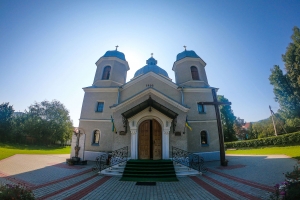
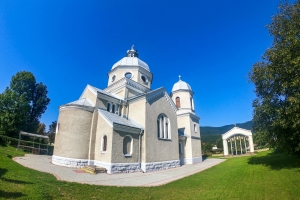
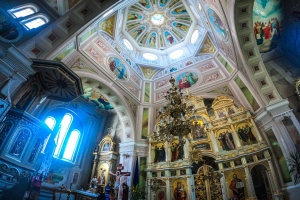
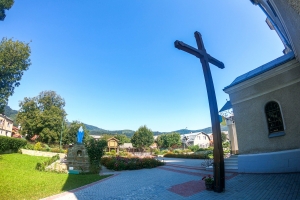
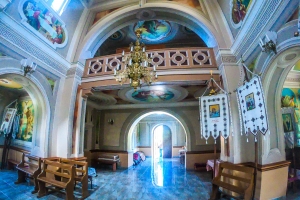
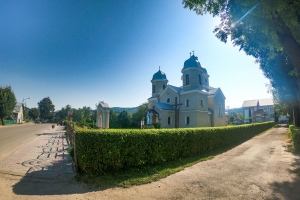
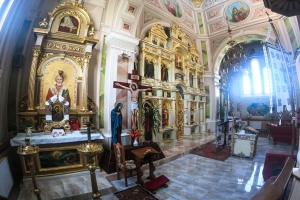

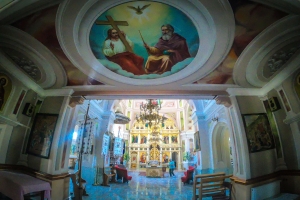

Until the end of the 19th century, Skole — ringed by mountains on every side — had only one church, an old wooden one. Then, in 1896, a new one rose nearby, bigger and brighter, and within a few years it took over as the town's main church.
The Church of the Nativity of the Theotokos remains the heart of religious life in Skole to this day — and a great excuse to detour into the center of this Carpathian town on the way up into the mountains.
Quick facts
| Location | Skole, Stryi district, Lviv region |
| Distance | ≈ 120 km south of Lviv |
| Time needed | 20–30 min (more if you also visit the neighboring wooden church) |
| What to bring | modest clothing for the church, a camera (for the exterior), respect for services in progress |
What it is and why people come
The Church of the Nativity of the Theotokos is Skole's main stone church, the center of the town's religious life since the late 19th century. It stands in the town center, close to the main square, so it fits naturally into a short walk through the center.
There's a separate reason to come — context. A few steps away stands Skole's oldest wooden church, the Church of St. Panteleimon (formerly St. Paraskeva). Together they show two faces of Galician sacred architecture: the old Boiko wooden tradition and the later stone tradition.
History
The Church of the Nativity of the Theotokos appeared in Skole in 1896. Before that, the town had only one church — the old wooden Church of St. Paraskeva (now St. Panteleimon). The new church, more modern and spacious, immediately became the main one.
In 1944–1945 the church was under repair, and during that time services were moved to the wooden Church of St. Panteleimon. So for centuries the two churches of Skole have backed each other up, passing the baton of parish life back and forth.
The neighboring wooden church is said to date back to around 1597 — one of the oldest surviving examples of Boiko wooden architecture, a landmark of national significance.
Legends and lore
Sacred sites in the Carpathians rarely come without their own stories — and Skole is no exception.
1. A wooden church that has outlasted centuries
Locals speak proudly of the neighboring Church of St. Panteleimon: they say it has stood without a single nail since the 16th century and has witnessed every misfortune that has passed through the Opir valley. Wood that has outlasted several empires is already a legend in its own right.
2. A prince's blood by the Opir
Skole is also linked to an older legend: that it was in these valleys, on the banks of the Opir, that Prince Sviatoslav Volodymyrovych died back in 1015. It has no direct connection to the church, but it gives the whole town a sense of deep, almost epic antiquity.
What to see and do
The Church of the Nativity itself. A late-19th-century stone church — the main landmark of Skole's religious life. Step inside (outside of services) if it's open, or admire the facade and churchyard.
The wooden Church of St. Panteleimon. A must-see neighbor. One of the oldest wooden churches in the Boiko region — don't skip it just for a quick look at the newer church.
Skole's town center. A few minutes from the church to the main square, the palace of the Hredel barons, and the banks of the Opir river. A logical route for a single walk.
How to get there
By car. From Lviv, take the M06 highway through Stryi to Skole, about 120 km (1.5–2 hours). The church is in the town center, near the main square.
By train. Skole sits on the Lviv–Stryi–Mukachevo line. From the station to the center and the church is a few minutes' walk.
By bus. Regular services from Lviv and Stryi; get off in the center of Skole.
Traveler's checklist
- Modest clothing — this is an active church, not just a monument.
- Time for both churches — the stone and wooden churches together give the full picture.
- A camera — for the exterior and the churchyard.
- Small cash — for a candle or donation.
- What NOT to do: photograph during services or enter in overly revealing clothing.
Frequently asked questions
Can you go inside the church?
Usually yes — it's an active church. It's best to come outside of services and behave quietly and respectfully.
How does the Church of the Nativity differ from Skole's wooden church?
The Church of the Nativity is the main stone church, built in 1896. The wooden Church of St. Panteleimon is much older and is a landmark of Boiko architecture. Both are worth seeing.
How much time should I set aside for a visit?
For the church itself — 20–30 minutes. If you add the neighboring wooden church and a walk through the center of Skole, plan for half a day.
Is it safe to travel to Skole right now?
Skole is a quiet town in western Ukraine that welcomes tourists as usual. As everywhere, it's worth paying attention to air raid alerts.
The Church of the Nativity of the Theotokos doesn't claim to be the Carpathians' top tourist "star" — and that's exactly why it's worth a visit. It's a living parish around which the everyday life of Skole has revolved for over a century.
Detour here on your way into the mountains, and in half an hour you'll see two eras of Galician church-building side by side — wood and stone, antiquity and the 19th century, standing just a few steps apart.
JoomShopping Download & Support