


- You are here:
-
Sights by Regions

-
Kyiv region
-
Kyiv
- Andriyivskyy Descent (Andriyivskiy Uzviz), Kyiv

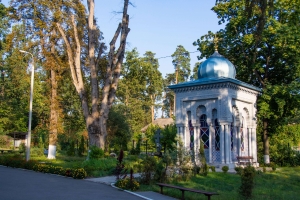
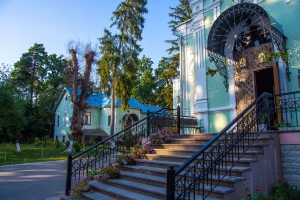

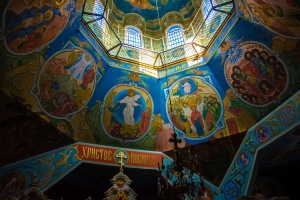

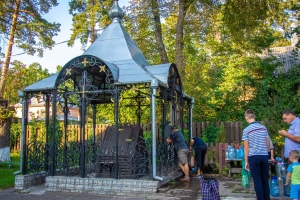
A pre-revolutionary tram runs to this church through a pine forest. And next to the wooden church stands a miniature crypt designed by the same architect who created Kyiv’s famous House of Chimeras.
The Church of St Seraphim of Sarov is a wooden temple from 1910 in the heart of Pushcha-Vodytsia, Kyiv’s old dacha (summer-cottage) suburb. Pines, silence, century-old walls, and the unexpected name of Horodetsky in its story — all of it half an hour by tram from the edge of the city.
Location Card
| Location | Kyiv, Obolonskyy district, Pushcha-Vodytsia |
| Built | 1910 (consecrated 12 December) |
| Material | timber on a stone foundation |
| Status | active church |
| Time needed | 30–40 minutes (half a day if combined with a forest walk) |
What It Is and Why It’s Worth the Trip
Serafymivska Church is the perfect excuse to visit Pushcha-Vodytsia, arguably the greenest corner of Kyiv. A wooden church from the early 20th century among the pines looks as though the capital stops here and a quiet provincial world begins.
People come for three things: the church itself, a stroll through the old dacha settlement with its canals and ponds, and the legendary tram route that crawls through the forest. This is a classic day-off route, with the church as the highlight but not the only one.
History
In 1903, the year St Seraphim of Sarov was canonised, Kyivans with summer dachas in Pushcha-Vodytsia decided to build a church in honour of the new saint. By spring 1904 a small wooden chapel had been erected and consecrated on 13 May; it was soon visited by Metropolitan Flavian himself, who blessed the building of a full church.
Initially, in 1905, a stone church designed by architect I. Nikolaev was approved, modelled on the Oleksandro-Nevska Church in Lypky. But funds were short, and in 1908 the decision was made to build a wooden church on a stone foundation. Construction began on 8 June 1910, and the church was consecrated on 12 December of that same year — a remarkably fast timeline for the era.
Timber and Brick at Once
The church is a hybrid construction: the first tier was faced with brick and plastered, while the drum of the dome and the upper tier of the bell tower were left in timber. The result looks solidly masonry from below and warmly rustic from above. Despite decades of Soviet rule, the church has survived and remains active.
Legends and Curious Facts
The dacha past of Pushcha-Vodytsia left behind more stories than it might seem.
1. A Crypt by Horodetsky
Next to the church stands a small chapel-crypt from 1913 attributed to Vladyslav Horodetsky — the same architect behind Kyiv’s iconic House of Chimeras and the St Nicholas Roman Catholic Cathedral. Finding the handwriting of Kyiv’s Art Nouveau master in a quiet forest suburb is a genuine surprise.
2. A Cure for the Nerves
At the turn of the 19th and 20th centuries Pushcha-Vodytsia was developed as a dacha resort: pine air, canals, and ponds were considered good for health. The church was built for that dacha-going crowd — making it from the very start a place that was less a country village church than a «wellness-and-capital» one.
What to See on Site
The church itself. A timber-and-brick church with a distinctive bell-tower silhouette — a rare surviving example of wooden ecclesiastical architecture in Kyiv.
The chapel-crypt. The miniature 1913 structure beside the church, associated with Horodetsky’s name.
The Pushcha-Vodytsia forest and canals. Pine woods, old dacha houses, and a network of ponds surround the church — ideal to combine with the visit.
The church was originally designed in stone. The money ran out — and it is precisely thanks to that shortfall that Kyiv ended up with one of its few surviving wooden churches from the early 20th century.
Getting There
By tram (the most atmospheric option). A historic tram line runs to Pushcha-Vodytsia from Kontraktova Ploshcha metro station through the Minsky housing estate. The ride through the forest is part of the experience.
By car. Head for Pushcha-Vodytsia, Obolonskyy district. The road runs through the forest; street parking is available near the church.
By public transport. In addition to the tram, city buses and minibuses serve the settlement from the Obolon side.
Visitor Checklist
- Modest clothing: an active church — women should cover shoulders and knees and bring a headscarf.
- Comfortable shoes: there is forest and dirt paths all around; it’s worth exploring the settlement.
- Cash: for a candle or donation; card readers are not everywhere in this leafy part of town.
- What NOT to do: photograph services or worshippers without permission, or make noise on the grounds.
Frequently Asked Questions
Is the church still in use?
Yes, it is an active church. Visitors are welcome during services and during the day; please be quiet and respectful.
Is there an admission charge?
Entry is free. Donations are welcome.
Did Horodetsky really design the crypt?
The 1913 chapel-crypt beside the church is attributed to Vladyslav Horodetsky — the architect of the House of Chimeras. It is one of the main talking points of this location.
What’s the most interesting way to get there?
By tram through the forest from Kontraktova Ploshcha — the journey itself is already part of the adventure. Car and bus are also options.
Serafymivska Church is the Kyiv that hides behind pine trees at the very edge of the city. A wooden temple that has survived a century, a quirky crypt, and a tram that still crawls through the forest — reason enough to escape the metropolis for half a day without ever leaving it.
JoomShopping Download & Support