


- You are here:
-
Sights by Regions

-
Kyiv region
-
Fastiv
- Church of Exaltation of Holy Cross, Fastiv


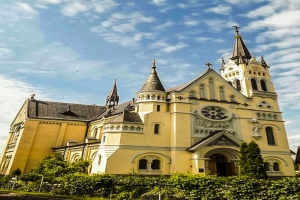
Among the prefab apartment blocks and market bustle of Fastiv, a sharp brick spire suddenly rises — something that belongs in the vicinity of Krakow or Lviv rather than an hour’s drive from Kyiv. This is the Church of the Exaltation of the Holy Cross, almost the only historic building to have survived everything the last hundred years threw at Fastiv.
It took eight years to build, was closed for half a century, and was returned to its congregation partly thanks to the world’s first female cosmonaut. A story that is hard to believe until you are standing beneath these walls yourself.
Location Card
| Location | 4 Yaroslava Mudroho St, Fastiv, Kyiv Oblast |
| Distance from Kyiv | ~75 km (1–1.5 hrs by car or commuter train) |
| Time needed | 30–60 minutes |
| What to bring | wide-angle lens (the spire won’t fit in a standard frame), modest clothing if entering, small change for a donation |
What It Is and Why Visit
The Church of the Exaltation of the Holy Cross is an active Roman Catholic parish church and one of the purest examples of neo-Gothic architecture in Kyiv Oblast. Romanesque-Gothic forms, pointed windows, a soaring spire — all the things visitors usually travel to western Ukraine to find are right here in Fastiv.
People come for two reasons. First, the architecture: against a backdrop of standard Soviet-era construction the church looks like an accidental visitor from another era. Second, its history — a story in which Polish nobility, the Haidamaka uprisings (18th-century Cossack-peasant revolts in Right-Bank Ukraine), Soviet repression, and an unexpected revival at the end of the 1980s are all tangled together.
History
The Catholic community in Fastiv predates the current building by a long way. The town went through several wooden churches: one was consecrated in 1751 by Bishop Kajetan Sołtyk, but in 1768 it was destroyed by Haidamakas during Koliivshchyna (a major Cossack-peasant uprising). The last wooden church was built in 1791, funded by Bishop Kaspar Cieciszowski.
By the early 20th century the 1790s wooden church could no longer hold all the parishioners. In 1903 the then-rector, Stanisław Szeptycki, began construction of a brick church. The work took eight years and was completed in 1911.
The exterior decoration was carried out by Italian sculptor Elio Sala — the same craftsman who worked on the St Nicholas Roman Catholic Church in Kyiv.
The Soviet Years
In 1934, at the height of the anti-religion campaign, the church was closed. After World War II an Orthodox congregation used its walls for some time. Paradoxically, this turned out to be the building’s salvation: a church in active use is far less likely to be demolished and stripped for bricks.
The Return
In 1989 the church was returned to Fastiv’s Catholic community, with active support from Valentyna Tereshkova, the world’s first female cosmonaut. In 1990 the church was consecrated for the second time. Since then it has been in continuous use and has gradually become a notable spiritual and charitable centre of the city.
Legends and Local Lore
Old churches always accumulate stories — and Fastiv’s is no exception.
1. The Church That Was Claimed Twice
Locals like to say the church «survived because it was never left empty»: first Catholic, then Orthodox, then Catholic again. They say this is precisely why the walls are still standing when dozens of other churches in the area were torn down for building materials.
2. The Cosmonaut and the Church
The story of Valentyna Tereshkova helping to return the church is retold in Fastiv almost as a legend — the combination of a symbol of Soviet space exploration and a Roman Catholic cathedral is simply too unexpected. But it is not a myth; it is a documented fact about the 1989 handover.
What to See on Site
The façade and spire. The main reason to visit. Pointed portals, brick lacework, a sharp spire — classic Romanesque-Gothic from the turn of the 19th–20th centuries. Best shots in the morning or at sunset, when the brick warms in colour.
The interior. If you get inside between services, take a quiet look at the vaulted ceiling and the altar area. Remember: this is an active place of worship, not a museum.
A walk through central Fastiv. The church is one of the few surviving historic buildings in the city, so it makes sense to pair your visit with a short stroll through the old quarter.
How to Get There
By car. From Kyiv — about 75 km on the road towards Fastiv, roughly one to one and a half hours. In the city the address is 4 Yaroslava Mudroho St.
By commuter train. Fastiv is a major railway junction; trains from Kyiv run regularly. The church is a short walk or a few minutes by local transport from the station.
Traveller’s Checklist
- Wide-angle lens or panorama mode — the spire won’t fit in a standard shot.
- Modest clothing if you plan to go inside.
- Small change for a donation.
- Check the service schedule if you want to enter, not just photograph the façade.
What not to do: walk in with a camera during a service or photograph worshippers — this is a functioning church, not a tourist attraction.
Frequently Asked Questions
How much does admission cost?
Entry is free — it is an active church. A donation towards the upkeep of the building is customary.
Can you go inside?
Yes, but the most reliable time is during or after a service. Outside service hours the doors may be locked.
How long should you allow for a visit?
Viewing the façade and a short walk through the centre takes 30–60 minutes. Easy to combine with a wider day trip through Kyiv Oblast.
When is the best time to photograph the church?
Morning or sunset: the raking light brings out the texture of the brick and makes the spire more striking.
Fastiv’s church does not try to impress with scale — it simply stands where it has stood for over a century, while almost everything around it has been rebuilt several times over. Haidamakas, Bolsheviks, wars, changes of power — and the sharp brick spire still points at the sky.
Sometimes the most interesting thing in a town is the one building they never managed to tear down.
JoomShopping Download & Support