


- You are here:
-
Sights by Regions

-
Kyiv region
-
Bila Cerkva
- Dendro Park «Olexandria», Bila Tserkva


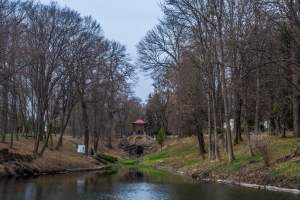

More than 300 hectares, nearly 20 kilometres of paths, and trees older than most of the towns around them. The Oleksandriia Arboretum in Bila Tserkva is Ukraine’s oldest and largest dendropark — over 235 years old and still full of surprises.
It was founded by a countess whom rumour called the illegitimate daughter of Catherine II. It has a colonnade that carries a whisper from one end to the other, and ponds whose banks, according to local lore, were deliberately planted with poison. A place where botany meets a historical mystery.
Location Card
| Location | Bila Tserkva, Kyiv Oblast |
| Distance from Kyiv | ~85 km (1.5 hrs by car) |
| Size | 300+ ha, ~20 km of paths, ~2,500 plant species |
| Time needed | 3–5 hours (comfortably — half a day) |
| What to bring | comfortable shoes (distances are real), water, snacks, camera, blanket for the lawn |
In This Article
- What it is and why visit
- History
- Legends and local lore
- What to see on site
- How to get there
- Frequently asked questions
What It Is and Why Visit
Oleksandriia is a state dendrological park under the National Academy of Sciences of Ukraine. Founded in 1788, it remains the oldest and largest park of its kind in the country: over 300 hectares, about 20 kilometres of paths, and approximately 2,500 plant species.
But people don’t come just for the botany. This is a classic English landscape park: meadows that open onto unexpected vistas, ponds, artificial «ruins», columns, bridges, and waterfalls. You can spend half a day here and miss half of it — or simply lie on the grass under an old oak and go nowhere at all.
History
The park was founded in 1788 by Oleksandra and Franciszek Ksawery Branytsky. The family had owned Bila Tserkva and the surrounding lands since 1774, and Oleksandriia became first their summer, then their main residence.
The park is named after Oleksandra Vasylivna Branytska (née Engelhardt; 1754–1838). She was an influential lady at the imperial court, and gossip attributed to her an illegitimate descent from Catherine II. She is considered the driving force behind the park and personally oversaw its development.
Until 1917, Oleksandriia belonged to three generations of the Branytsky family. The last owner was a Frenchwoman, Maria Yevstafiyivna Branytska.
Decline
After the abolition of serfdom in 1861, work in the park slowed: the free labour force was gone. The Soviet era dealt a harder blow — valuable pieces were stolen, trees felled, park structures demolished. Part of the Branytsky vision was lost forever.
Second Life
In 1946 the arboretum was transferred to the National Academy of Sciences of Ukraine, which manages it to this day. The scientific status brought systematic restoration: during the 1957 works, for instance, the Column of Sorrow was reinstated.
Legends and Local Lore
An old aristocratic park simply cannot exist without legends — and Oleksandriia has its share.
1. The Poisoned Shores
One of the best-known tales concerns the ponds. Local lore says the Branytskys ordered the banks planted with poisonous plants — to stop peasants fishing in the noble family’s waters. Whether true or exaggerated is for you to judge, but the story perfectly captures the spirit of an era when this park was strictly private territory.
2. The Whispering Colonnade
The «Luna» colonnade is famous for its unique acoustics: a word whispered at one end carries clearly to the other. Try it yourself — this is one of those rare cases where the «legend» actually works in front of you, as long as you bring a friend and stand at opposite ends.
What to See on Site
«Luna» Colonnade. The park’s headline attraction thanks to its acoustics. A must if you’ve come with company.
The «Ruins» and Waterfall. Artificial romantic ruins — a classic feature of 18th–19th-century landscape parks. A waterfall flows from beneath them, and the lower tier acts as a retaining wall for the dam of Laznevyi Pond.
Column of Sorrow. Reinstated during the 1957 restoration, one of the park’s most recognisable structures.
The Ponds. Including Rusalka (Mermaid) Pond — the one tied to the poisoned-shores legend. Beautiful scenery and peaceful spots to rest.
Paths and Meadows. Around 20 km of walkways: it’s easy to lose yourself for half a day here, and that’s the best thing that can happen.
How to Get There
By car. From Kyiv — about 85 km towards Bila Tserkva, roughly 1.5 hours. Parking is available near the entrance.
By public transport. Regular buses and minibuses run from Kyiv to Bila Tserkva. From the city centre, take local transport or a taxi to the main entrance of Oleksandriia.
Tip. Plan for at least half a day. The park is vast, and rushing through in an hour means seeing almost nothing.
Traveller’s Checklist
- Comfortable shoes — the distances here are serious.
- Water and a light snack: a café may not be near the path you want.
- A blanket if you plan a picnic on the lawn.
- Camera — the colonnade, ruins, and ponds are photogenic in every season.
- Spare time: half a day flies by without you noticing.
What not to do: pick plants or leave the paths in protected zones — this is a scientific arboretum, not an ordinary city park.
Frequently Asked Questions
How long do you need for the park?
Comfortably — half a day. The minimum to see the highlights is 3–4 hours: the park is big, with around 20 km of paths.
When is the best time to visit?
Beautiful in any season, but most spectacular in late spring when everything blooms, and during golden autumn. In summer the shade of the old trees is a welcome refuge.
Is the park suitable for children?
Yes. Plenty of open space, paths, and meadows. The main things to bring are comfortable shoes and enough water, as the distances add up.
Does the Luna colonnade really carry a whisper?
Yes, the «Luna» colonnade has exactly that acoustic quirk — the easiest way to confirm it is to stand at opposite ends with a friend.
Oleksandriia has outlasted its counts, survived a revolution, endured Soviet felling, and come back to life as a scientific park. History here isn’t printed on plaques — it grows in the trees, whispers through the colonnade, and guards the legend of shores that were once dangerous to approach.
Come without hurrying. The park is over 235 years old — it is definitely in no rush, and neither should you be.
JoomShopping Download & Support