


- You are here:
-
Sights by Regions

-
Kyiv region
-
Bila Cerkva
- Church of St. George, Bila Tserkva
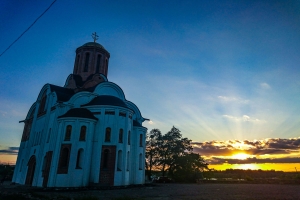
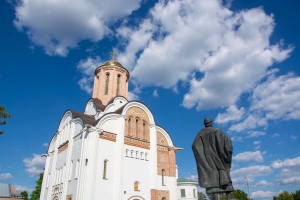


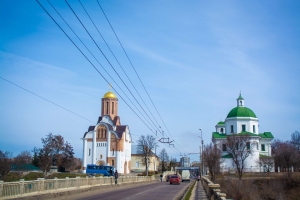


In 1032, Yaroslav the Wise founded a fortress town on the banks of the Ros River and named it Yuriv — after his Christian name, Yuri (George). Almost a thousand years later, a Church of St. George once again stands on that very hill.
And here's the best part: according to legend, it was that white stone church that gave the entire city its present-day name.
Quick facts
| Location | Castle Hill, Bila Tserkva, Kyiv region |
| Distance from Kyiv | about 85 km (53 mi) south |
| Time needed | 20–40 minutes (longer if combined with a walk around town) |
| What to bring | a camera, a headscarf, curiosity about ancient history |
What it is and why people come
St. George's Church stands on Castle Hill — the historic core of Bila Tserkva. It's a modern building, reconstructed following the model of Kyivan Rus churches from the 11th–13th centuries: compact, single-domed, with tall narrow windows resembling arrow slits.
People come here for more than prayer. This is a place where the city's very origins lie literally underfoot: it was here that Yaroslav the Wise founded the fortress of Yuriv, with a citadel built around it. The church is a kind of pin on the map connecting today with the 11th century.
History
It all began in 1032, when Prince Yaroslav the Wise founded a fortified town on the Ros River and named it Yuriv, after his baptismal name Yuri (George). One of the early dioceses of the Kyivan state was based here — the Diocese of St. George on the Ros, mentioned in Byzantine lists of dioceses dating back to the first half of the 11th century.
During the Lithuanian-Polish era, a castle was built on the site of the old citadel, and the original church was dismantled. It seemed nothing remained of the first temple. But in the 1980s, archaeologist Ruslan Orlov discovered the foundations of an ancient structure on Castle Hill — a physical trace of that original Yuriv.
A 21st-century rebuild
The present-day St. George's Church was built in 2011–2013 by a local charitable foundation set up by Kostiantyn Yefymenko. Rather than a new build from scratch, it was a reconstruction based on standard designs of princely-era churches — so the stone on Castle Hill could once again speak the language of the 11th century.
Almost a thousand years separate Yuriv's first church from the one standing today. The hill, though, is the same.
Legends and lore
The main legend here isn't about ghosts — it's about the city's name itself. And it's worth the trip on its own.
1. The white church that named the city
According to legend, after the Mongol invasion Yuriv lay in ruins — but a white stone church survived among the ashes. Travellers passing through used it as a landmark: "the place with the white church." That, the story goes, is how the name Bila Tserkva ("White Church") became attached to the city from the late 15th century onward.
2. St. George the protector
St. George the Victorious is the patron saint of soldiers, and for a frontier town like Yuriv, that was no random choice. The city stood on the edge of the steppe, taking the first blows from nomadic raiders, so a warrior saint on banners and above the church carried a very practical meaning — guarding the border.
What to see on site
The church itself. A compact, single-domed church in the spirit of Kyivan Rus architecture — narrow arrow-slit windows, austere forms, a sense of fortress-like restraint. A completely different aesthetic from the ornate baroque of later centuries.
Castle Hill. The historic heart of the city and a viewpoint at the same time. From here it's easy to see why the fortress was built right here: elevation, a river, natural defences.
A walk to Oleksandriya Park. Bila Tserkva is best known for its enormous landscape park, Oleksandriya. It makes sense to combine a visit to Castle Hill with a walk there — together they fill a full day.
How to get there
By car. About 85 km (53 mi) south of Kyiv on the M05 highway (Kyiv–Odesa). The drive takes roughly an hour and a half. In the city, head for Castle Hill.
Public transport. Buses and minibuses run regularly from Kyiv to Bila Tserkva (departing mostly from bus stations near Kyiv's main bus terminals). From there, take local transport or walk to Castle Hill.
Tip. Set aside time for the city itself: Bila Tserkva is compact but has plenty to offer, so it would be a shame to rush through in 10 minutes.
Traveller's checklist
- Bring: a camera — the single-domed church on the hill is very photogenic.
- Bring: a headscarf and modest clothing for entering the church.
- Bring: comfortable shoes — you'll need to climb the hill.
- Plan: combine the visit with Oleksandriya Park.
- Don't: reduce the trip to a single photo — the real draw here is the story of the place.
Frequently asked questions
Did the church really give the city its name?
This is the most widespread version of the name's origin: according to legend, a white stone church survived the destruction, and the landmark "white church" became attached to the city's modern name. There are other historical explanations too, but this legend is the best known.
Is the church old or new?
The current building is modern — it was reconstructed in 2011–2013. But it stands on the historic Castle Hill, where Yaroslav the Wise founded the town of Yuriv and its first church back in 1032.
How far is it from Kyiv?
About 85 km (53 mi), roughly an hour and a half by car on the M05 highway. By bus, it takes about the same, plus a transfer to local transport in the city.
What else is worth seeing nearby?
The city's main highlight is Oleksandriya Park, one of Ukraine's largest landscape parks. It pairs well with a visit to Castle Hill.
Most cities take their names from rivers, princes, or early settlers. Bila Tserkva, if the legend is to be believed, owes its name to a single surviving structure — a white church that outlasted an invasion.
So next time you're standing on Castle Hill, remember: this might be exactly where the name now carried by an entire city began.
JoomShopping Download & Support