


- You are here:
-
Sights by Regions

-
Kirovohrad region
- Abandoned Morozovsky coal quarry, Pantanyivka
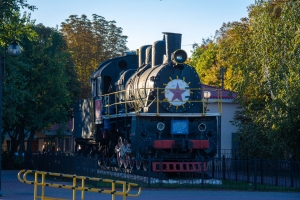


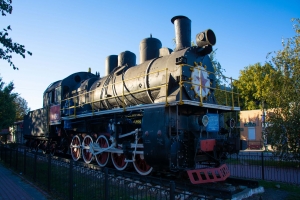
In late 1943, while smoke still hung over the town, a heavy black steam locomotive rolled cautiously into the wrecked Znamianka station. The tracks were torn up and the station building lay in ruins, but the engine made it through. This locomotive — according to local tradition, the first to reach the liberated station — now stands on a pedestal by Pryvokzalna Square (Station Square).
Znamianka is a rare kind of town: it didn’t grow up around a fortress or a monastery — it was born from rails. Here, the railway isn’t just transport, it’s the town’s biography. And a steam locomotive monument is the most honest symbol such a town could give itself.
Location card
| Location | Znamianka, by the railway station, Kirovohrad region |
| Distance from Kropyvnytskyi | ~45 km (28 mi) northeast |
| What to see | the Eu-683-21 steam locomotive on its pedestal, the historic station building, the railway junction |
| Access | free, outdoors, open 24/7 |
| Time needed | 20–40 minutes (easy to combine with a train arrival or departure) |
What it is and why it’s worth a stop
Standing on its pedestal by the station is a genuine mainline steam locomotive — not a model, not a scaled-down replica, but a multi-tonne machine that was once stoked with coal and hauled long freight trains. The number on its side reads Eu-683-21, a member of the “E” family, the most numerous series of Soviet-era freight locomotives that hauled cargo across this part of Europe’s railways for decades.
People don’t come here for fancy architecture — they come for the feeling. Standing next to a wheel taller than you are, touching the cold metal that remembers stokers and coal dust, is a different kind of conversation with history than the one you have at a typical obelisk. It’s also the perfect five-minute stop for anyone with a layover — the Znamianka junction is still one of the key hubs on the Odesa Railway.
History: a town born from the railway
Znamianka is a classic “railway town.” While settlements elsewhere grew up around a marketplace or a church, here everything revolved around the station. In the 1870s a line opened toward Mykolaiv, and later toward Fastiv, and the former village at the crossing of these routes quickly turned into a junction of tracks, depots, workshops, and thousands of railway workers.
The steam locomotive as the engine of this story isn’t a metaphor — it’s literally how it happened. The depot provided jobs, the station set the rhythm, and the locomotive whistle was the town’s clock. So when the town was liberated from Nazi occupation in late 1943, the most urgent task wasn’t rebuilding the square — it was getting the trains running again.
For a railway town, the first train into the liberated station meant more than any speech. It meant one thing: life was coming back.
That’s where the idea for the monument came from. A locomotive on a pedestal is both a tribute to the railway workers who kept the junction running during and after the war, and a memory of the very day the wheels started turning again.
Local lore and railway tales
Old steam locomotives always collect stories — partly true, partly polished by generations of train drivers.
1. The very first one
Local tradition holds that the locomotive placed on the pedestal isn’t just any engine, but the very one that was first to reach the liberated station. That’s hard to confirm in the records — but in railway towns, stories like this are guarded more carefully than statistics.
2. The engine that outlasted its crews
“E”-series locomotives stayed in service so long that a single engine could outlast several generations of crews. Old railway workers used to joke that the machine doesn’t get retired — it decides for itself when it’s ready.
What to see on site
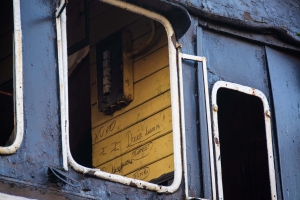
The locomotive itself. Walk all the way around it — the level of detail is more impressive up close than it looks from a distance: connecting rods, axle boxes, huge driving wheels, the driver’s cab. From a low angle, the machine looks especially monumental.
The station and the junction. Znamianka station is a working hub, not a museum piece. Trains are constantly being shunted here, and in fifteen minutes you can see more rail action than at many regional capitals.
Plaques and memorial details. There are usually explanatory plaques near the pedestal — worth reading to connect this hunk of metal to a specific date and the people behind it.
How to get there
By train. The most logical option: Znamianka is a major junction served by trains in many directions. The monument is a few minutes’ walk from the platform, so it’s easy to see even during a layover.
By car. From Kropyvnytskyi, it’s about 45 km (28 mi) northeast. The landmark in town is simple — head for the railway station, the locomotive stands right next to Pryvokzalna Square.
By bus. From the Znamianka bus station to the railway station is a few minutes across town — any local will know the way.
Traveler’s checklist
- Camera or phone: low-angle shots by the wheel come out the most striking.
- Train schedule: if you’re catching the monument between connections, keep an eye on the clock.
- Comfortable shoes: the station area means asphalt, curbs, and a bit of walking.
- Respect the railway: this is a working station — don’t step onto the tracks for a photo.
What NOT to do: don’t climb onto the pedestal or into the driver’s cab — the metal is old, the drop is real, and station security won’t appreciate it.
Frequently asked questions
How much does it cost to visit?
Nothing. The monument stands outdoors by the station and is freely accessible at any time.
Is it worth visiting with kids?
Yes, especially if your child loves trains. There’s a working station with shunting trains right next door — a free little show.
How much time should I plan for?
15–20 minutes is enough for the locomotive itself. If you want to watch the junction for a while, plan for half an hour to an hour.
Is it safe to visit right now?
Znamianka is in central Ukraine, and the town goes about its everyday life. As everywhere in the country, follow air raid signals and local authority guidance.
Most monuments tell stories about people. This one tells a story about movement — about a town that simply wouldn’t exist without rails, and about the day its wheels started turning again.
So if fate ever lands you at the Znamianka junction with an hour to spare, don’t just sit on the platform. Walk out to the square, circle the black machine — and you’ll understand more about this town than any guidebook could tell you.
JoomShopping Download & Support