


- You are here:
-
Sights by Regions

-
Kirovohrad region
- Abandoned Morozovsky coal quarry, Pantanyivka
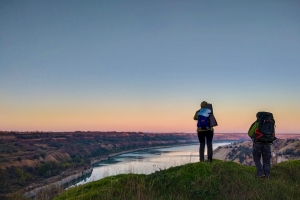

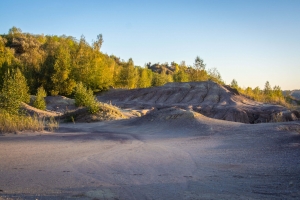
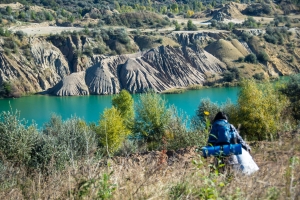
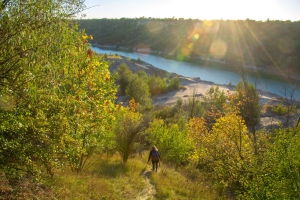


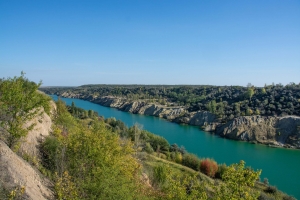
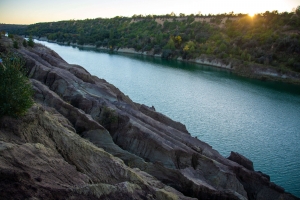

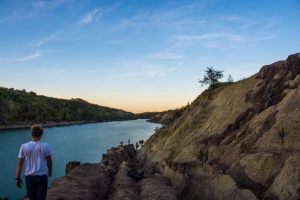
Picture this: you’re standing on the edge of a cliff, and below your feet lies clear, impossibly turquoise water more than twenty metres deep — somewhere down in that blue-green darkness, a four-thousand-tonne Soviet excavator rests on the bottom. No fence, no ticket booth, no security guard with a walkie-talkie. Just you, the wind, and the ruins of one of Ukraine’s largest lignite open-cut mines.
The Morozivskyi quarry near Pantaivka is what happens when Soviet heavy industry surrenders and quietly sinks beneath the water. Literally.
Location card
| Location | Oleksandriia district, Kirovohrad region; village of Pantaivka (between Morozivka and Novoselika) |
| From Kropyvnytskyi | ~85 km north (E50 highway, Oleksandriia — Kropyvnytskyi) |
| From Oleksandriia | ~15 km |
| Time needed | 2–4 hours (walking the perimeter + viewing the machinery) |
| What to bring | Sturdy footwear (slopes can crumble), water, a charged phone, sunscreen; swimwear — if you find a gentle-slope section |
| Entry | Free; no security on site |
In this article
- What it is and why visit
- History: coal, records, and decline
- Legends and fascinating facts
- What to see on site
- How to get there
- Traveller’s checklist
- Frequently asked questions
What it is and why visit
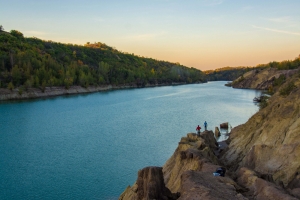
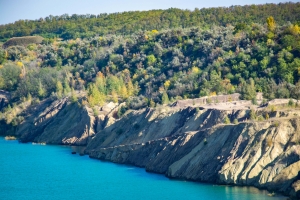
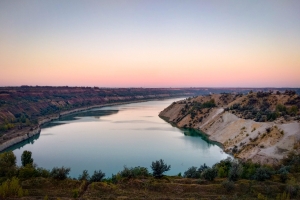
The Morozivskyi coal quarry is a former open-cast lignite (brown coal) mine that, after its closure in 2009, gradually filled with groundwater and transformed into a six-kilometre L-shaped lake with water the colour of a tropical sea. Only instead of coral reefs on the bottom, you get Soviet excavators weighing several thousand tonnes each.
People come here for three reasons: to see the turquoise water — a colour utterly out of place in the Kirovohrad steppe — that now fills the pit where coal once was; to track down half-submerged industrial machinery that scrap-metal scavengers haven’t yet stripped away; and simply to stand on the edge of a man-made canyon where industrial apocalypse turns out to be unexpectedly beautiful.
The Morozivskyi quarry features on the unofficial list of Ukraine’s 7 most compelling urban-exploration sites — alongside the Chornobyl Exclusion Zone and decommissioned military bases.
History: coal, records, and decline
Lignite in the heart of Ukraine
Central Ukraine isn’t associated with coal — most people think of the Donbas for that. Yet the Kirovohrad region has been hiding lignite (brown coal) beneath its soil for millennia. The first serious industrial extraction attempts came at the start of the 20th century, but the real scale arrived in Soviet times: in 1976 the state enterprise Oleksandriavuhillia (Oleksandriia Coal) was founded — the largest operation in the Dnipro Lignite Basin.
Lignite is not anthracite — its calorific value is considerably lower. But its deposits lie close to the surface, making open-cast mining straightforward: strip off the topsoil and dig. Cheap, if ugly. The payback? Turquoise lakes afterwards. Nature has its own way of compensating.
Opening of the Morozivskyi quarry
The Morozivskyi quarry opened in 1970. By the standards of Soviet industry it was an instant behemoth: planned capacity of 2.75 million tonnes of lignite per year. The pit expanded in an L-shape, eventually stretching 6 km in length and reaching depths of more than 20 metres.
To haul spoil from one side of the quarry to the other, engineers installed a Bergvitz conveyor-stacker bridge — a steel structure more than 300 metres long that was at the time the only construction of its kind in Ukraine. It no longer exists, but its story is worth knowing — see below.
In 1976 the quarry was incorporated into Oleksandriavuhillia, and production reached its peak. During those years the pit ran around the clock; giant excavators bit into the rock face even through the night — an industrial Moloch in the middle of agricultural Kirovohrad country.
Decline and flooding
The collapse of the Soviet Union took the lignite industry down with it. Demand fell, subsidies dried up, and profitability became a fantasy. Output at Oleksandriavuhillia plummeted from 9.2 million tonnes in 1990 to 1.4 million tonnes in 1998 — a sixfold drop in just eight years. The Morozivskyi quarry struggled on, but in 2009 operations halted for good.
Nature moved in. Groundwater slowly but relentlessly filled the basin. Several thousand tonnes of machinery were left exactly where they stood. Some equipment was shipped off to scrapyards; some was stripped by freelance salvagers. But most simply sank with the quarry. The water level continues to rise today.
Legends and fascinating facts
The Morozivskyi quarry hasn’t accumulated folk tales about witches or buried treasure — it simply hasn’t had time: too young for legends in the classical sense. What it has instead is something better — real, verifiable facts that are just as breathtaking as any tall story.
1. A trophy from the Third Reich — now gone
The Bergvitz conveyor-stacker bridge was once the headline attraction of the Morozivskyi quarry. It was manufactured in Germany in 1933, long before any quarry existed at Pantaivka. After the Second World War it ended up among the vast quantities of industrial equipment requisitioned by the Soviet Union as war reparations. From Central Europe it travelled straight to the Ukrainian steppe, where it was put to work at the new Soviet open-cut mine.
Three hundred metres of steel that survived Nazi Germany and Soviet Oleksandriavuhillia. Independent Ukraine, however, it did not survive: in 2013 the state enterprise Central-Western Company “Vuhletorfrestrukturyzatsiia” (Coal and Peat Restructuring) signed a tender contract worth 15.4 million hryvnias to liquidate the quarry structures. By July of that year the bridge was 70% demolished, and before long it was entirely cut up for scrap. Today all that remains are archival photographs and the concrete footings in the ground.
2. A nine-storey excavator
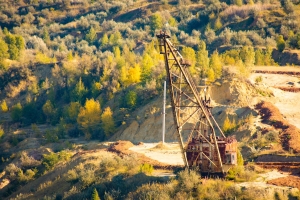
The bucket-wheel excavator ERShR-1600 that worked this quarry was not a “large machine.” It was a structure. Weight: approximately 4,000 tonnes. Height: roughly that of a nine-storey building. Output: 1,600 cubic metres per hour. Built at the Novokramatorsk Machine-Building Plant in the early 1970s, it was one of the largest machines of its type in the world.
The ERShR-1600 weighed more than ten fully loaded Boeing 747s. And by all accounts it now rests on the bottom of the quarry.
Most of the machinery has already disappeared beneath the water or been stripped for parts. But some remnants are still visible on the surface — and every piece of rusting metal tells a story of scale that is almost impossible to grasp while standing on a quiet green bank.
3. Tropical colour, no tropics required
Why is the water this colour? Locals sometimes spook visitors with talk of chemical contamination — but the actual explanation is both simpler and more elegant. Deep, clear water absorbs the red and yellow wavelengths of sunlight and reflects the blue-green spectrum. The deeper and cleaner the water, the richer the turquoise. Pure physics, no chemistry. That said, it’s still worth remembering this was an industrial site.
What to see on site
Panoramic viewpoints along the bank. The rim of the quarry functions as a natural observation deck. From here the entire L-shaped basin comes into view: six kilometres of turquoise water framed by spoil heaps. Sunsets here are something else entirely — the water turns copper while the silhouettes of rusting machinery darken against the horizon like props from a post-apocalyptic film.
Remains of industrial machinery. Some equipment still sits on the surface or is only partially submerged. Illegal metal scavengers are gradually reducing what’s left — what you see today may well be gone tomorrow. Walk the bank and look for buckets, frames, and conveyor fragments.
Swimming spots. In certain sections the bank slopes gently enough for swimming — locals and tourists regularly take a dip here. The water looks clean. Steep sections must be avoided: the depth increases sharply at the base of the slopes and the ground can collapse without warning.
How to get there
By car from Kropyvnytskyi (~85 km). Head north on the E50 highway towards Oleksandriia. After passing through (or around) Oleksandriia, continue to Pantaivka. The quarry sits between the villages of Pantaivka, Morozivka, and Novoselika — dirt tracks lead straight to the bank. Pin the coordinates in Google Maps or maps.me before you set off.
By car from Oleksandriia (~15 km). The most convenient option. Oleksandriia is the nearest town where you can fill up with fuel and stock up on food and water before heading out.
By public transport. Buses run from Oleksandriia to Pantaivka; check the current schedule at the bus station or ask locals. From the bus stop it’s still a few kilometres to the quarry on foot or by bicycle — a folding bike in the car boot is a smart idea.
Road conditions. The approach roads are unpaved tracks that turn into a muddy challenge after rain. Low-clearance cars may struggle. An SUV or 4WD vehicle is the sensible choice.
Traveller’s checklist
Pack these:
- Sturdy closed-toe shoes: quarry slopes are unstable — trainers built for flat pavement won’t cut it here.
- Food and water: there are no cafes or shops on site; the nearest are in Oleksandriia or Pantaivka.
- Fully charged phone: with offline navigation, because the dirt roads aren’t always obvious.
- Sun protection: open water and a flat steppe landscape create double reflection — you’ll burn faster than you expect.
- Swimwear (optional): if you plan to take a dip at one of the gently sloping sections, there’s room to wade in.
What NOT to do:
- Stand near the quarry edge in unreliable footwear or lean out for a “better angle” — the ground here gives way without warning.
- Climb on the bridge structures — they haven’t been maintained in decades.
- Enter the water where the bank is steep: depth increases sharply at the base of the slopes.
- Leave litter: this is one of the few places in the Kirovohrad region that hasn’t yet become a dump.
Frequently asked questions
Is it safe to swim in the Morozivskyi quarry?
Locals and tourists regularly swim at the gently sloping sections, apparently without incident. However, no official water-quality tests have been conducted, and steep banks must be avoided entirely: depth increases sharply at the base of the slopes. Only swim where you can wade in gradually.
Can I bring children?
Teenagers — yes, but constant supervision near the banks is essential. For younger children the site is not well suited: no proper beach, no toilets, no cafe, and the terrain demands attention. If your kids are under 10, a proper supervised beach is the better call.
When is the best time to visit?
May–September. The turquoise effect is most vivid in summer and you can combine sightseeing with a swim. Early morning or late evening is the sweet spot for photographers: raking light turns industrial ruins into something straight out of an exhibition. In winter the quarry is eerie and atmospheric, but the dirt roads may be impassable.
Do I need special permission to visit?
No. The quarry is officially abandoned, there is no security, and entry is free. Formally it may be private or state-owned land, so act responsibly.
Are there places to stay nearby?
Not immediately at the quarry. The nearest option is Oleksandriia (~15 km), which has hotels and hostels. Some visitors camp on the bank overnight — no one will stop you, but spending a night without a torch on the edge of a quarry in the dark is a solid argument for bringing a headlamp.
Is it safe to visit during the ongoing war?
The Kirovohrad region is far from active combat zones, and the Oleksandriia district is not classified as a high-risk area. Always check the current situation through official sources before travelling, as conditions can change.
The Morozivskyi quarry is a place where Soviet industry didn’t merely collapse — it was transformed. Forty years of noise, smoke, and millions of tonnes of coal, and what remains is a lake that appears on no original map. A trophy bridge hauled from Nazi Germany, which served for more than thirty years, has vanished into a scrapyard. A nine-storey excavator sleeps quietly on the bottom, as though it simply decided to rest forever.
Beauty comes in many forms. Sometimes it looks exactly like this.
JoomShopping Download & Support