


- You are here:
-
Sights by Regions

-
Kharkiv region
- Holy Transfiguration Church, Nova Vodolaga


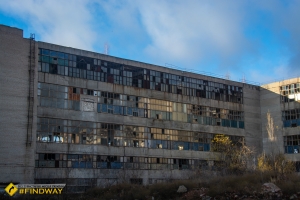
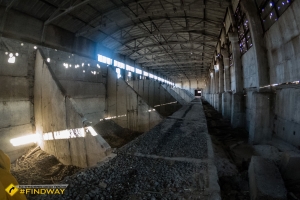


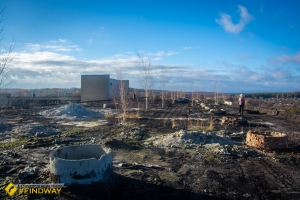


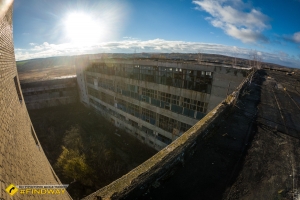

On 2 November 2021 a six-storey building collapsed in a matter of seconds — brought down deliberately by controlled demolition. Gone was the factory that had once produced one in every three faience plates in the Soviet Union and sustained an entire township.
Budiansky Faience Factory in the settlement of Budy near Kharkiv is the story of the rise and fall of an entire era of Ukrainian ceramics. This is where the famous dinner services with the «singing rooster» motif were born — and all that remains now are ruins and the memory of a legendary enterprise.
Location card
| Location | Budy urban-type settlement, Kharkiv district, Kharkiv Oblast |
| What it is | abandoned (partially demolished) faience factory |
| Founded | 1887 (by industrialist M. Kuznetsov) |
| Time needed | 1–1.5 hours |
| Bring | sturdy footwear, a camera, caution |
Safety note
Budy is in Kharkiv Oblast, which has been under the threat of strikes since 2022. Check the current security situation before visiting. On the site itself there are the typical hazards of abandoned and partially demolished buildings: unstable structures, broken debris and risk of collapse after the demolition. The territory may also have an owner — respect that.
What it is and why it matters
Faience is not just tableware. For several generations of Ukrainians, plates, cups and dinner services «from Budy» were part of the home. Budiansky Factory was one of the largest faience producers not only in Ukraine but across the entire USSR, and its artistic output is still prized by collectors and museums today.
People come here to grasp the scale of what has been lost: a vast industrial complex where work once hummed, now wrapped in silence. This is a site about industrial memory — and about how quickly a legend can become a ruin.
In the 1970s the factory produced up to 80 million items a year — 34% of all faience in the USSR. Products were exported to Germany, France, Poland, Turkey and the Baltic states.
History: from Kuznetsov to bankruptcy
The factory was founded in 1887 by Matviy Kuznetsov, the so-called «Porcelain King» of the Russian Empire. The plant quickly became the heart of the settlement: with Kuznetsov’s funding, Budy gained a hospital, a bathhouse, a school for workers and their children, a craft college, dormitories and even a telephone line. One in four residents of the settlement worked at the factory — the entire life of Budy revolved around faience.
The factory was destroyed during World War II but fully rebuilt by 1953. A golden age followed: annual output reached 80 million items in the 1970s and products were shipped worldwide.
End of an era
The 1990s and 2000s proved fatal. The factory could not compete with cheap Chinese imports flooding the market. On 2 November 2006 the Economic Court of Kharkiv Oblast declared «Budiansky Faience» bankrupt. Exactly fifteen years later, on 2 November 2021, the six-storey building was demolished at the owner company’s order. The coincidence of dates felt symbolic — as if life itself had placed a full stop.
The legend of the «singing rooster»
The factory’s most recognisable symbol is the rooster motif painted on its tableware.
Plates featuring the «singing rooster» became true classics of Ukrainian faience. Many families still keep them on their shelves — a warm reminder of home.
Budy’s artists developed a whole school of decorative painting, and their works are held in museums. So the factory left behind not only ruins but also an aesthetic instantly recognisable at first glance.
What to see
The factory grounds. The scale of the former production is impressive even in ruin.
Museum collections of Budiansky faience. The best way to understand the factory’s significance is through its products — look for them in Kharkiv’s museums.
The settlement of Budy itself. The housing and infrastructure built around the factory’s history — Kuznetsov’s enduring legacy.
Getting there
By car: about 25 km south-west of Kharkiv.
Public transport: suburban trains and buses run from Kharkiv to Budy.
Traveller’s checklist
- ✅ Check the security situation in the region
- ✅ Sturdy closed-toe footwear
- ✅ Camera for industrial photography
- ✅ See Budiansky faience in a museum for the full picture
- ❌ Do not enter unstable or collapsed buildings
- ❌ Respect private property
Frequently asked questions
Why did the factory close?
The plant could not compete with cheap Chinese imports and was declared bankrupt in 2006; its main building was demolished in 2021.
How much faience did it produce?
In the 1970s, up to 80 million items a year — around 34% of all faience output in the USSR — exported to many countries.
Is there anything to see now?
Some buildings have been demolished, but the site and several structures remain. Supplement your visit with a look at Budiansky faience in a museum for the full picture.
Budiansky Faience Factory is the story of a giant that fed a whole township and supplied tableware to half of Europe — then lost to cheap imported plates and vanished in seconds of controlled demolition. But the «singing rooster» still looks out from shelves in thousands of Ukrainian homes — and as long as it does, the factory lives on in its own way.
JoomShopping Download & Support
Attention! Part of Ukraine was occupied during Russia's unfounded military aggression against us and other democratic countries!
russia is a terrorist country, russians are murderers, thieves and rapists.
Russia's unhuman aggression against Ukraine since 2014 has led to the loss of homes and lives not only of many Ukrainians, but also of citizens of other countries and nationalities.
We consider any military actions against any state in the 21st century unacceptable and stupid, but unfortunately the Russians do not think so, and therefore many democratic countries, including Moldova, Georgia and our homeland, suffer from barbaric aggression.
Therefore, until the occupied parts of Ukraine are demilitarized and returned to our state, we remind users about the real danger of visiting the territories occupied by russia.