


- You are here:
-
Sights by Regions

-
Kharkiv region
- Abandoned stables of Nataliyvskyi park, Volodymyrivka

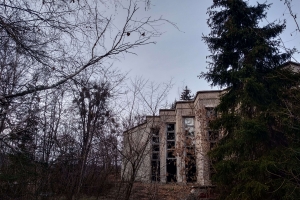
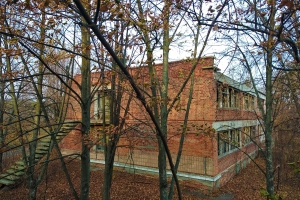


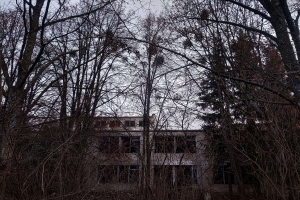
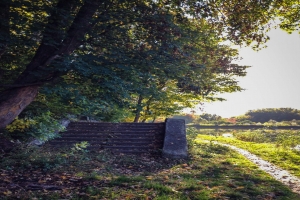
Among the pines near Pivdenne stand peeling buildings where a bugle once rang out, children laughed, and counsellors gave their orders. Now only the wind in the treetops remains — yet another Soviet children’s camp that outlived its era and was left empty.
The abandoned pioneer camp near Pivdenne is a classic urban exploration site in Kharkiv Region. Don’t confuse it with the neighbouring «Druzhba» camp of the Serp i Molot (Hammer & Sickle) factory: the Pivdenne area hides several derelict camps scattered through the forest.
Location Card
| Location | near Pivdenne, Kharkiv Region |
| What it is | abandoned Soviet pioneer (children’s) camp |
| Condition | derelict, buildings in ruins |
| Time to explore | 1–2 hours |
| What to bring | torch, sturdy footwear, water, power bank |
What It Is & Why Come Here
During the Soviet era, dozens of pioneer camps (Soviet-era children’s summer camps run by factories, institutions, and state agencies) were built in the pine forests around major cities. The Pivdenne area with its conifer forests served as a kind of «camp belt» near Kharkiv. When the system collapsed, no one was left to maintain them — and one by one they emptied out.
This camp is one of them. People come here for the distinctive atmosphere of an abandoned childhood: peeling dormitory blocks, the remains of a canteen, a parade ground where groups of children once lined up. The pine forest adds silence and melancholy to every photo. Not a wow-factor location — but deeply atmospheric.
Several abandoned camps survive near Pivdenne. This one is separate from the well-known «Druzhba» camp of the Serp i Molot factory, but the atmosphere is the same: silence where noisy children’s summers once rang out.
History: A Summer That Ended for Good
The precise institutional history and dates of this particular camp are poorly documented: like many such sites, it has no official record in tourism sources. But the broad story is typical and easy to understand.
In the Soviet decades the camp lived to its familiar rhythm: summer sessions, vouchers for workers’ children, morning roll calls, campfires, film screenings. After the USSR collapsed, funding evaporated and no one was left to maintain the infrastructure. Children stopped coming, belongings were gradually stripped, and the buildings were handed over to time and nature. Today they are ruins in the forest — another monument to a childhood happiness that was cut short.
Legends & Local Lore
Abandoned children’s camps are the reigning champions of ghost stories. The contrast between «it was happy here» and «there’s no one here now» does its work.
1. The Bugle That Plays Itself
The classic legend: at dawn a «bugle call» can supposedly be heard from the direction of the parade ground — as if an invisible camp is waking up for morning exercises. Almost certainly wind and imagination, but the story refuses to die.
2. The «Quiet Room»
Urban explorers single out one building that feels «unusually quiet» and «uncomfortable.» The psychology of abandoned spaces: the mind adds its own anxiety where crowds once were. But the story sharpens the experience.
3. The Lost Session
A romantic legend about the «last session» that supposedly «never went home.» Of course this is a metaphor — an image of how abruptly the camp’s life ended at the close of its history.
What to See & Do
The dormitory blocks. The main draw: peeling walls, empty window openings, occasional remnants of children’s paintings.
The canteen and club. Usually the largest buildings, with remnants of a stage for end-of-session performances.
The parade ground. Where the daily roll calls were held — now overgrown with grass.
The pine forest. Beautiful in its own right, adding that melancholy quality to every shot.
Getting There
By car. The reference point is the town of Pivdenne in Kharkiv District. The camp is in the forest zone nearby; check the exact location on satellite maps and recent explorer reports.
By public transport. Take a suburban service from Kharkiv to Pivdenne, then walk to the forest.
Safety note. This is Kharkiv Region — a front-line area. Always check the security situation in the specific community before travelling.
Explorer’s Checklist
- Torch: the buildings are dark even in daylight.
- Sturdy closed-toe shoes: broken glass, rebar, debris.
- Water and snacks: no facilities on site.
- Power bank: for navigation and photography.
What NOT to do: climb onto unsafe floors or rooftops; go alone; ignore the front-line context; stray off marked paths — Kharkiv Region has a persistent risk of unexploded ordnance.
Frequently Asked Questions
Is this the same as the «Druzhba» camp?
No. Several abandoned camps survive near Pivdenne. This one is separate from the well-known «Druzhba» camp of the Serp i Molot factory, though the atmosphere is similar.
Is it safe to visit?
This is front-line Kharkiv Region: the main risks are shelling and potential unexploded ordnance, plus unstable structures. Check the local security situation, stay on paths, and do not enter ruined buildings.
Can I bring children?
Not recommended. Derelict buildings, sharp debris, and the security risks of a front-line region make this site unsuitable for children.
Is there an entrance fee?
No. The site is unmanaged, with no ticket booth or security. The buildings may have an owner, however — act responsibly.
The abandoned pioneer camp near Pivdenne is yet another quiet monument to a Soviet childhood that ended with the country that invented it. Peeling dormitory blocks, an overgrown parade ground, pine trees all around.
Walk quietly, don’t destroy what is still standing, and remember: behind every peeling wall was once someone’s best summer. And while the region remains a front-line zone, the best way to respect this place is with caution.
JoomShopping Download & Support
Attention! Part of Ukraine was occupied during Russia's unfounded military aggression against us and other democratic countries!
russia is a terrorist country, russians are murderers, thieves and rapists.
Russia's unhuman aggression against Ukraine since 2014 has led to the loss of homes and lives not only of many Ukrainians, but also of citizens of other countries and nationalities.
We consider any military actions against any state in the 21st century unacceptable and stupid, but unfortunately the Russians do not think so, and therefore many democratic countries, including Moldova, Georgia and our homeland, suffer from barbaric aggression.
Therefore, until the occupied parts of Ukraine are demilitarized and returned to our state, we remind users about the real danger of visiting the territories occupied by russia.