


- You are here:
-
Sights by Regions

-
Chornobyl Exclusion Zone
-
Pripyat
- Sixteenfloors apartment Fujiyama, Pripyat

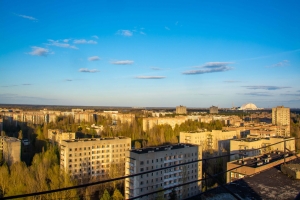


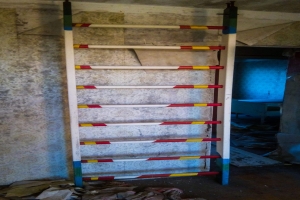
Among Pripyat’s typical concrete blocks, this building stands out from a distance: 16 floors, a white silhouette and a distinctive crown on the roof that recalls a snow-capped peak. That profile is why residents nicknamed it «Fuji» — after Japan’s Mount Fuji.
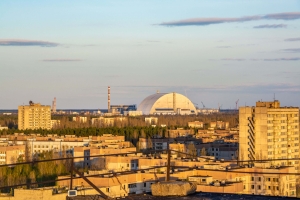
It is one of the tallest buildings in the ghost city and one of its most recognisable landmarks. The Soviet coat of arms still clings to the facade — the very emblem that watched over the main square for decades. Today, from «Fuji’s» empty windows, you can see the forest swallowing Pripyat and the silhouette of the Chornobyl Nuclear Power Plant on the horizon.
Quick Facts
| Location | Pripyat, Chornobyl Exclusion Zone, Kyiv Region |
| What it is | abandoned 16-storey residential high-rise |
| Nickname | «Fuji» — from the shape of the roof |
| Abandoned | since 27 April 1986 |
| Time needed | 15–30 minutes as part of a route |
What it is and why visit
Pripyat was built as the model city of the future for workers at the Chornobyl Nuclear Power Plant: wide boulevards, brand-new nine- and sixteen-storey blocks, everything according to the latest word in Soviet urban planning. «Fuji» was one of the city’s defining high-rises, visible from many points across the skyline.
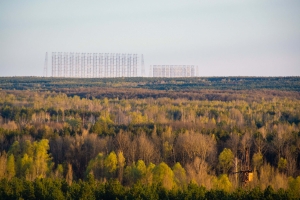
People come here for two shots. The first is the coat of arms on the facade: a symbol of an era literally frozen in time. The second is the view from above: the rooftops of Pripyat, forest pushing through the asphalt, and the power plant in the distance. This is one of those places where the scale of the catastrophe becomes something you feel physically.
The city meant to be the showcase of Soviet prosperity became the world’s most famous ghost town. And the coat of arms on «Fuji» still hangs there as if nothing happened.
Why «Fuji»
Officially this is just a standard residential block. But the building’s rooftop has a distinctive finishing piece — a white «crown» whose silhouette recalls the snow-capped summit of Mount Fuji. Hence the popular name, which has stuck among stalkers and guides.
Such nicknames are typical of Pripyat: the city has its own «White Houses,» «Europa» and other spots given informal names by people who come here. «Fuji» is one of the most apt: an exotic Japanese name against the backdrop of a Soviet coat of arms creates exactly the kind of contrast that draws visitors here.
History: the city that stopped in one day
Pripyat was founded in 1970 alongside the construction of the Chornobyl Nuclear Power Plant. It was a young, prosperous-by-Soviet-standards city: the average age of residents was around 26, shops were well stocked, there was a swimming pool, a Palace of Culture and an amusement park. «Fuji,» with its coat of arms, was part of that parade of plenty.
Everything ended on 26 April 1986, when Reactor No. 4 exploded. The following day, 27 April, the city was evacuated in a matter of hours. Nearly 50,000 people boarded buses thinking they would return within days. No one has lived in «Fuji’s» apartments since.
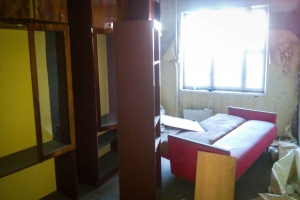
Over the decades the building gradually fell into ruin: broken windows, crumbling staircases, nature clawing through concrete. But the frame still stands and the coat of arms still clings — and that is precisely what makes the block so recognisable.
What to see
The coat of arms on the facade. The building’s signature feature and one of Pripyat’s iconic symbols. Best seen from below, standing at the foot of the tower.
The rooftop silhouette. The «Fuji» shape that gave the building its name. The best shots come from a distance, when the whole outline is visible.
City panorama. The height makes this block a natural observation point: from up here you get a sweeping view over Pripyat, the encroaching forest and the power plant. Important: going up is at your own risk and only where your guide permits.
Status after 2022
In spring 2022 Russian forces temporarily occupied the Chornobyl Exclusion Zone, including Pripyat. After de-occupation, sappers checked parts of the territory, and access to certain locations and routes may still be changing. Before visiting, always confirm the current status with a licensed tour operator.
Getting there
Pripyat is a restricted area inside the Chornobyl Exclusion Zone. Entry is possible only with a licensed tour and an official pass.
- Starting point: organised tours depart mainly from Kyiv.
- Documents: passport for the entry permit, compliance with Zone regulations.
- In the city: «Fuji» is visited as part of a walking route together with other Pripyat sites.
Visitor tips
- Avoid entering damaged stairwells unnecessarily. Stairs and floor slabs in old high-rises are unreliable.
- Take nothing with you. It is prohibited, and objects may be contaminated.
- Follow your guide. They know which areas are accessible and which are strictly off-limits.
- Fully covering clothing and sturdy footwear are mandatory.
Frequently asked questions
Why is the building called «Fuji»?
Because of the roof shape: the white crown on top of the high-rise resembles the snow-capped summit of Japan’s Mount Fuji. It is a popular nickname that has stuck among guides and urban explorers.
Can you go up to the roof?
People do climb up for the panorama, but it is dangerous: the staircases and floor slabs are old and unreliable. Only attempt this at your own risk, and only where your guide explicitly allows it.
Is it safe to visit Pripyat?
A short visit as part of a licensed tour is considered relatively safe in terms of radiation exposure. The main risks are unstable buildings and the potential for unexploded ordnance in areas not yet cleared after 2022. Visit only through an organised, licensed tour.
Is the coat of arms still on the building?
Yes, the Soviet coat of arms on the facade of «Fuji» is one of its defining features and a popular photo subject.
JoomShopping Download & Support