


- You are here:
-
Sights by Regions

-
Chornobyl Exclusion Zone
-
Pripyat
- Ghost Town Pripyat, Chornobyl Exclusion Zone


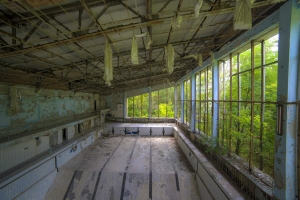

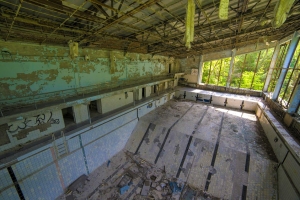
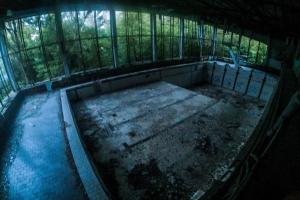
Five lanes, two diving platforms, a glass facade, and pale-blue tiles. The Lazurny pool in Pripyat kept running for twelve years after the fourth reactor at ChNPP exploded. Liquidators swam in that water — between shifts on the sarcophagus.
Today all that remains is an empty concrete shell, crumbling tiles, and a broken clock on the wall. Yet this shell is recognized worldwide — thanks to a single Call of Duty mission and thousands of frames from stalker photo reports. Lazurny became the face of dead Pripyat.
Location Card
| Location | Pripyat, Sportyvna St., Chornobyl Exclusion Zone (Ivankiv district, Kyiv region) |
| Year opened | 1970 |
| Year closed | 1998 (12 years after the ChNPP disaster) |
| Main pool | 25 m, 5 lanes, two diving platforms |
| Access | official Exclusion Zone tours only; currently restricted due to the war |
| Time to visit | 30–40 minutes (typically part of a full-day city tour) |
| What to bring | respirator or dust mask, closed-toe shoes with thick soles, flashlight, bottled water, dosimeter (optional) |
In This Article
- What Lazurny Is and Why People Come Here
- Technical Specifications
- History: From Opening to the Last Water Change
- Why the Pool Ran for 12 Years After the Disaster
- Legends, Rumors, and Dark Stories
- Lazurny in Pop Culture
- What to See on Site
- Today: War, Occupation, and Access
- How to Get There
- Traveler’s Checklist
- Frequently Asked Questions
What Lazurny Is and Why People Come Here
Lazurny is more than a swimming pool. It was part of a large sports complex that Soviet Pripyat built on Sportyvna Street for its 50,000 residents. Under one roof: a 25-metre five-lane pool, a small children’s pool, a basketball court, and a gymnastics hall.
Soviet logic dictated that “the nuclear workers’ city must be first in everything.” Pripyat genuinely was a model city: the average resident was 26 years old, wages were the highest in the Ukrainian SSR, scarce goods were freely available in shops, and there was a dedicated sports complex with a pool for the children of ChNPP workers.
Today Lazurny is one of three essential stops on any Pripyat tour, alongside the Ferris wheel and School No. 3. People come to:
- see the iconic empty shell — the one from a thousand photographs;
- step “inside Call of Duty” — gamers arrive like pilgrims;
- feel the contrast: pale-blue tiles that outlasted two generations set against crumbling concrete;
- capture the shot that needs no caption.
Technical Specifications
In photos the pool looks compact, but it was a fully equipped training facility:
- Main pool: 25 m long, 5 lanes — standard for district-level competitions.
- Depth: variable; up to 4 m under the diving platforms, approximately 1.2 m in the shallow end.
- Diving platforms: two structures, one of which included a full springboard and a high-dive platform.
- Auxiliary pool: a smaller shell for children’s groups and swimming lessons.
- Sports complex: basketball court, gymnastics hall, showers, changing rooms.
- Architecture: classic Soviet functionalism of the 1970s — long glass facade, sky-blue tiles, concrete beams.
Five lanes, two diving platforms, a glass wall facing south. For a Soviet city of 50,000 in 1970, this was a dream sports facility. Today it is the most famous empty swimming pool in the world.
History: From Opening to the Last Water Change
The 1970s: Young Pripyat
The pool opened in 1970 — alongside the city itself, designed to serve the future ChNPP. Pripyat was launched as the ideal Soviet city: new residential blocks, tree-lined avenues, schools, the Prometei cinema, and — naturally — a sports complex with an indoor pool. In a country where most small towns made do with a stadium and a pond, a 25-metre pool with diving platforms was a mark of privileged status.
By 1986, thousands of children had passed through: swimming lessons, diving clubs, sports schools. On weekends Lazurny served families — memberships allowed three visits a week.
26 April 1986: Evacuation
At 1:23 a.m. on 26 April, the fourth reactor at ChNPP exploded. The city was evacuated on 27 April from 2:00 p.m. — in an orderly fashion, by bus, “for three days.” No one came back: residents were resettled across Kyiv, Zhytomyr, and neighboring regions, and Pripyat was sealed — seemingly for good.
And then the water was left in the pool. Chlorinated, relatively clean, with functioning pumps and filters. That simple fact decided the fate of Lazurny for the next twelve years.
1986–1998: A Pool for the Liquidators
Within weeks of the accident, liquidators began arriving in the zone: soldiers, miners, engineers, drivers, pilots. Thousands of people lived in rotation in makeshift camps and in Pripyat itself. They needed a basic quality of life — a canteen, showers, a medical unit. And separately — somewhere to “wash the day off.”
That place was Lazurny. Water was changed regularly, tiles were scrubbed, radiation readings carefully monitored. By multiple accounts from liquidators, the pool was one of the cleanest sites in all of Pripyat — cleaner than the apartments where years of radioactive dust had settled.
The last water was drained sometime around 1996–1998, when it became clear there would be no further large-scale work in the city itself. No one knows the exact date — it was never recorded in any official document.
Why the Pool Ran for 12 Years After the Disaster
This is the strangest fact about Lazurny — and it has several entirely practical explanations.
First, water shields against radiation. A metre of water reduces gamma exposure significantly; a shell four metres deep functions as a small protective bunker. Swimming in the pool was safer than sitting on a bench in the courtyard outside.
Second, the pool was regularly decontaminated. Tiles were washed, water was filtered and periodically drained. In a building where people worked every day, dust had no time to settle and “hold” radionuclides.
Third, liquidators needed it — physically and psychologically. Miners digging a tunnel beneath the reactor, engineers on the sarcophagus, soldiers clearing the rooftops — all worked in conditions where even washing properly was a challenge. A hot shower and 25 metres of pool were an island of pre-war normalcy in the middle of the Zone.
In a dead city where radiation had settled on everything — from the asphalt to the furniture — the pool turned out to be one of the safest places around. A paradox that deserves its own book.
Legends, Rumors, and Dark Stories
An abandoned pool at the epicenter of a nuclear disaster is perfect ground for urban legends. Some are entirely true; others exist only in stalker chat groups. Here are the three you hear most often.
1. The Clock That Stopped at 1:23
For many years a large analog clock hung on the pool wall. Stalkers claimed its hands were frozen at 1:23 — the moment the reactor exploded. Reality is more prosaic: the clock simply stopped when its mechanism wore out. The 1:23 you see in photographs is mostly coincidence or a staged shot. But the story lives on.
2. The “Last Swim” of the Liquidators
Among liquidator veterans, a story circulates about the final organized swim in the pool — said to have taken place on the day the decision to permanently close the facility was made. Men who had worked here for months came to “say goodbye to the water” and swam their 25 metres — each one alone. It is not documented anywhere, but the story passes from person to person at veterans’ gatherings.
3. The Catfish in the Flooded Basement
Another stalker favorite: a giant catfish supposedly lives in the groundwater-flooded basement of the sports complex. The logic is thin — the basement has no connection to any open waterway — but photos of “the Pripyat catfish” circulate online regularly. The most likely explanation involves ordinary catfish from the Prypiat River that grew to remarkable sizes in the ChNPP cooling pond. None of that has any connection to this pool. But the legend stuck here anyway.
Lazurny in Pop Culture
There is a separate reason why the pool’s name is recognized in gaming circles from San Francisco to Seoul.
Call of Duty 4: Modern Warfare. In the iconic mission “All Ghillied Up” (2007), the player crawls through abandoned Pripyat as a sniper — and a key sequence unfolds in the sports complex and beside the empty pool. For an entire generation of gamers, Lazurny came to embody the feeling of “an abandoned Soviet city” long before they ever learned its real name.
S.T.A.L.K.E.R. The Ukrainian game series by GSC Game World drew on the image of the empty pool in several locations, though no exact replica of Lazurny appears in the games. The atmosphere — absolutely.
Documentaries and photo projects. The Lazurny shell appears in virtually every major documentary about Chornobyl — from HBO to National Geographic. It is a visual shortcut: “this is what a dead city looks like.”
What to See on Site
Unlike other points in Pripyat, Lazurny does not require a long visit. Everything you want to see is in one large hall. But here are the details worth paying attention to.
The shell and starting blocks. The first thing you notice: five neat numbered blocks and a shell lined with blue tiles. Much of the tiling has fallen away; some has been cemented over by water seeping for decades. Debris and pieces of structure are often visible on the floor.
The diving platforms. Both metal platforms remain in place. Do not attempt to climb them — the structures are rusted and fixings are 50+ years old. From below — photogenic and unsettling.
The clock on the wall. The one from the 1:23 legend. It still hangs there, though its condition worsens every year. A good shot.
The glass wall (or what remains of it). The southern wall of the pool was almost entirely glass. The panes are gone now, but the frames are in place — light pours through them, creating the characteristic “cinematic” atmosphere of every Lazurny photograph.
Graffiti on the walls. Since the zone reopened to tourists, the walls above the pool have filled with graffiti — from genuine street art to the obligatory “Vasya was here.” A separate layer of cultural sediment.
The adjoining sports complex. The same building houses a basketball court and gymnastics hall. If time allows — take a look. Less famous, but equally atmospheric.
Today: War, Occupation, and Access
In February 2022, Russian forces temporarily occupied the Exclusion Zone, entering from Belarusian territory. The occupation lasted until the end of March. During that time the area was mined, partially looted, and the radiation monitoring infrastructure near ChNPP was damaged. After the withdrawal the Zone was largely closed to all visitors.
As of 2026, tourist access to Pripyat — including the Lazurny pool — remains restricted. Individual official visits are organized by the State Agency of Ukraine on Exclusion Zone Management for journalists, scientific groups, and official delegations. The mass tourism that existed in 2018–2021 has not resumed.
Before planning any trip, always verify the current access status through the official Agency resources and licensed tour operators. Entering the Zone without official authorization is a criminal offense — regardless of how romantic the idea may seem.
How to Get There
By car (organized groups only): from Kyiv, head north on highway P-02 through Ivankiv to the Dytyatky checkpoint (Exclusion Zone entrance). Distance: approximately 110 km; travel time about 2 hours 15 minutes. Private vehicles are not permitted inside the Zone — stopped at the checkpoint.
Tour from Kyiv: the only legal option for independent travelers. Tour operators arrange bus or minibus departure from central Kyiv, and provide permits, dosimeters, a safety briefing, and lunch. Trips are typically full-day, from morning to late evening.
Public transport to Pripyat does not exist — it is a closed city inside the Zone. No scheduled buses or minibuses run there.
GPS coordinates of the pool: 51.4071° N, 30.0581° E (Sportyvna St., sports complex).
Documents: international passport or national ID card, permit application submitted in advance (minimum 7 days). For foreign nationals — same requirements plus an additional form.
Traveler’s Checklist
What to bring:
- International passport or national ID (without it you won’t get through the checkpoint).
- Closed-toe shoes with thick soles — Pripyat is full of broken glass and rebar.
- Respirator or dust mask — for dust, not radiation.
- Long-sleeved clothing you don’t mind losing (occasionally a dosimeter beeps at the exit and you’re asked to leave items behind).
- Fully charged phone + power bank — signal in the Zone is weak, but you will want to take a lot of photos.
- Flashlight — the sports complex interior is dark even in daytime.
- Bottled water and a snack — lunch is usually included in a tour, but a backup never hurts.
- Dosimeter (optional) — available to rent from the tour operator; more fascinating than frightening.
What NOT to do:
- Do not touch objects inside the buildings, and especially do not take anything “as a souvenir” (it’s a criminal offense, not a keepsake).
- Do not sit on floors or parapets; do not place belongings on surfaces.
- Do not climb the diving platforms — the structures are unsafe.
- Do not fall behind the group — it is both dangerous and illegal.
- Do not smoke inside any buildings in the Zone.
Frequently Asked Questions
Can you visit the Lazurny pool right now?
As of 2026 — no. Access to Pripyat for ordinary tourists is closed due to the war and the aftermath of the Russian occupation of the Zone in 2022. Individual visits are arranged for journalists and scientific groups. Before any trip, check the current status with the State Agency on Exclusion Zone Management.
What is the radiation level inside the pool?
Before 2022, radiation inside the pool was low — comparable to Kyiv levels or slightly above. It is one of the cleanest sites in Pripyat thanks to the concrete, the tiles, and the fact that it was scrubbed regularly during the Soviet era. Current figures need to be verified with anyone who has had access since 2022.
Is it true that liquidators swam here?
Yes, it is a documented fact. The pool operated from 1986 until approximately 1998 and was used primarily by Chornobyl Nuclear Power Plant liquidators — as one of the few “clean” places for rest and personal hygiene inside the Zone.
How many lanes did the pool have?
Five. A standard 25-metre shell with five lanes, plus two separate diving platforms. The complex also included a small auxiliary pool for children’s groups.
Is this the pool from Call of Duty?
Yes. In the mission “All Ghillied Up” from Call of Duty 4: Modern Warfare (2007), the action unfolds in abandoned Pripyat, and the episode near the empty pool was inspired by Lazurny. That is one of the main reasons gamers around the world recognize this location.
Can you take children?
Officially — no. Exclusion Zone tours do not accept minors, even if access is eventually restored. This is less about radiation than about physical hazards: broken glass, collapsed ceilings, no guardrails.
Lazurny is a rare case where water proved stronger than catastrophe. While the rest of Pripyat settled into dust, this 25-metre shell kept living a kind of afterlife: exhausted liquidators swam laps in it, talked through their shifts, washed off what is hard to wash off.
When the pool was finally decommissioned, it became something more than a sports facility. An empty blue shell with starting blocks and a broken clock — it is a visual shortcut for the entire Chornobyl story. An image you recognize without a caption. It will appear in documentaries, be rendered in video games, reproduced in thousands of photo projects — and it will continue to do so as long as Pripyat exists and the memory of it endures.
If access to the Zone is ever restored and you find yourself standing at the edge of this shell — remember that the last people to swim here were not Soviet sporting hopes. They were engineers, miners, and soldiers who did someone else’s work so that the explosion of 1986 would not become something far worse.
JoomShopping Download & Support