


- You are here:
-
Sights by Regions

-
Chornobyl Exclusion Zone
-
Chornobyl
- Exposition of equipment of liquidators, Chernobyl
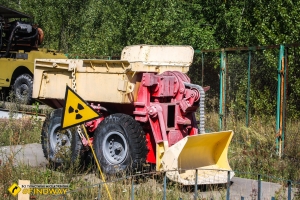


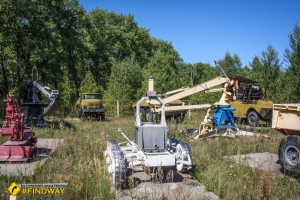
Over 600,000 liquidators, hundreds of vehicles, and only a handful of minutes a person could spend on the reactor roof. The machines endured what humans couldn't — and when the machines failed too, people went back up. The liquidator vehicle exhibition in Chornobyl is a monument to the machines that were first to fight the radiation.
On an open-air site in the town of Chornobyl you'll find robots, a helicopter, engineering and fire vehicles, and armored equipment. Each one carries its own short, dramatic story from the spring and summer of 1986.
Location card
| Location | Chornobyl, Exclusion Zone, Kyiv region |
| Distance | ~15 km from the Chornobyl NPP, ~130 km north of Kyiv |
| Type | open-air exhibition |
| Time needed | 20–40 minutes |
| Access | official tours only; as of 2022–2026 the Zone is closed to tourists |
| What to bring | a dosimeter, don't touch the vehicles, closed-toe shoes |
What it is and why people visit
The liquidator vehicle exhibition is a site in the town of Chornobyl displaying machines that worked on the cleanup of the 1986 disaster. Here you can see engineering, fire-fighting and special-purpose vehicles, plus robots that were built in a hurry to replace people in places where radiation killed within minutes.
Visitors come because this is a tangible, physical history of the catastrophe. It's one thing to read about the "roof of unit three" and roentgens per hour. It's another to stand next to a robot that the roof itself destroyed, and a dosimeter that's still reacting to the metal.
Robots on the reactor roof broke down within minutes — their electronics couldn't withstand the radiation levels. People then took over — they were called the “bio-robots.”
History
After Reactor No. 4 exploded on April 26, 1986, enormous resources were thrown into the cleanup. Vehicles hauled sand, lead and concrete, cleared rubble, fought fires and decontaminated land. Many machines absorbed such a dose that they could no longer be operated — they were sent to special storage sites.
The most famous of these is the vehicle graveyard near the village of Rassokha, where hundreds of helicopters, armored personnel carriers, engineering vehicles and fire trucks stood for years. Over time most of this equipment was cut up for scrap, and some "disappeared" through illegal removal of contaminated parts.
To preserve the memory, a number of representative vehicles were moved into a museum-style exhibition in the town of Chornobyl itself. This is no longer a "wild" graveyard but an organized site where every machine has an explanation and a role as an exhibit.
What to see on site
Remote-controlled robots. Self-propelled machines meant to clear debris off the reactor roof instead of people. Many broke down from radiation — which is exactly why they symbolize the limits of technology.
The helicopter. Aviation crews dropped tons of material into the burning reactor. One of the helicopters has become the site's centerpiece and most photogenic exhibit.
Engineering vehicles (IMR-type) and armored equipment. Tracked clearing vehicles and armored personnel carriers that worked in the most contaminated zones.
Fire trucks. The first responders to the reactor on the night of the disaster were the firefighters of Pripyat and Chornobyl — many of whom paid with their lives.
Stories and facts that hit hard
No legends needed here — reality is stronger than any myth.
1. Vehicles "hotter" than a person
Some vehicles absorbed doses high enough to remain dangerous for decades. That's why they couldn't simply be scrapped — and why visitors shouldn't touch the exhibits.
2. The vanished graveyard at Rassokha
Rassokha once held an entire "army of machines." Today almost nothing remains — the equipment was cut up and hauled away. The Chornobyl exhibition is one of the few places where you can still see this story up close.
Today: war and access
In late February 2022, Russian troops entering from Belarus seized the Exclusion Zone and held it for over a month. During that time, some sites in the Zone were looted and damaged. After liberation the territory returned to Ukrainian control, but tourist access remains closed due to martial law — as of 2026, no organized tours are running.
Before planning an actual trip, always check official announcements about the Zone reopening.
How to get there
Organized tours only. Chornobyl sits inside the Exclusion Zone. There's no independent way in — only licensed tours with permits (when access is open).
Route. Kyiv → the Dytiatky checkpoint → the town of Chornobyl. The vehicle exhibition is one of the first stops on a tour, before heading toward the power plant and Pripyat.
For now. While the Zone is closed, you can explore this equipment through museum online projects, documentaries, and the National Chornobyl Museum exhibition in Kyiv.
Traveler's checklist
- Dosimeter: the metal of the exhibits can still register radiation.
- Closed shoes and clothing: a general rule for the Zone.
- Permit and documents: a restricted area (when access is open).
- Camera: the site is highly photogenic.
What NOT to do: touch the vehicles, climb on them, take any parts, or wander off from the group.
Frequently asked questions
Can you visit the exhibition right now?
No. As of 2026 the Exclusion Zone is closed to tourists due to martial law. Visits will only be possible after access is officially restored.
Is the equipment itself dangerous?
Some exhibits may have elevated radiation levels, so they shouldn't be touched. Viewing from a safe distance as part of a tour is considered acceptable.
Is this the same as the Rassokha vehicle graveyard?
No. Rassokha was a former storage site where the equipment was later mostly cut up for scrap. The Chornobyl exhibition is an organized museum site with preserved examples.
How long does a visit take?
Usually 20–40 minutes — it's one stop within a full-day tour of the Zone.
The liquidator vehicle exhibition isn't really about metal — it's about the people who got behind the wheel of these machines knowing the cost of every minute near the reactor. Robots broke down, vehicles "burned out" from radiation — and the work went on.
Standing next to these silent machines, you start to understand the scale of the 1986 battle better than any number could show. And that's exactly why this place is worth preserving.
JoomShopping Download & Support