


- You are here:
-
Sights by Regions

-
Cherkasy region
- Butsky Canyon, Buki


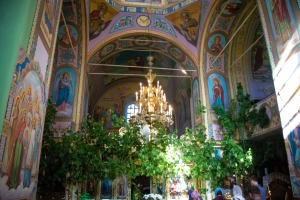

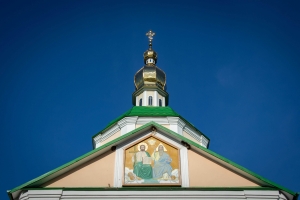


The white walls of the monastery stand on earthworks more than two thousand years old. First came a Scythian hillfort covering over 200 hectares, then a relic oak forest, then a convent that became one of the cradles of the Haidamaka uprising. Kholodnyi Yar knows how to layer epochs on top of each other.
Quick Facts
| Location | Kholodnyi Yar tract, Chyhyryn area, Cherkasy region |
| What it is | active women’s convent on a Scythian hillfort |
| Time to visit | 1.5–2 hours including the spring |
| What to bring | modest clothing for the church, water, comfortable shoes |
What It Is and Why People Come Here
The Holy Trinity Motronyn Convent is an active women’s monastery at the very heart of Kholodnyi Yar. It stands on the ramparts of the ancient Scythian Motronyn hillfort, surrounded by a relic oak forest with springs and streams.
People come here for three things at once: spiritual stillness, the history of the Cossack-Haidamaka rebellion, and the extraordinary nature of Kholodnyi Yar, where even in summer you feel a cool breath — which is exactly where the name of the tract comes from.
History
First came the steppe and the Scythians: the hillfort existed here in the 6th–4th centuries BC, and its ramparts survive to this day. A millennium later a monastery arose on the same site — documented in written records from the 16th century, initially as a men’s monastery, then from 1911 as a women’s convent.
The loudest chapter in the convent’s history belongs to the 18th century. Kholodnyi Yar and Motronyn Monastery became one of the focal points of the Koliivshchyna (Haidamaka uprising) of 1768. From here legend traces the «unconquered» spirit of Kholodnyi Yar, which in the 20th century became a symbol of the Ukrainian resistance movement.
The monastery stands on the ramparts of a Scythian hillfort covering more than 200 hectares — one of the largest in this part of Ukraine.
Legends & Mystery
1. Princess Motrona
According to legend, the monastery was founded by Princess Motrona. Grief-stricken by her husband’s death, she supposedly ordered a boat carrying his body to be sunk, then took the veil and founded the convent in his memory. Hydrologists have confirmed that a navigable river once flowed through the ravine — so the legend has a real foundation.
2. Gold from the Burial Mounds
Kholodnyi Yar is dotted with Scythian burial mounds, and it is said that the monastery once bought gold found by local diggers. How much truth there is in this is a question for historians, but the image of a convent guarding Scythian treasure adds a layer of mystery to the place.
What to See on Site
Trinity Cathedral and monastery courtyard. The heart of the convent: white walls in the forest, silence and a sense of a place that has been alive for centuries.
Scythian ramparts. The earthwork fortifications of the ancient hillfort, on which the monastery stands. Look at the contours of the ground — this is the handiwork of two thousand years ago.
St Onuphrius Spring. The well-known spring of Kholodnyi Yar, near the monastery — a traditional stop on the route.
Oak forest. Relic oaks of the tract, some of them genuine ancient giants.
Getting There
By car. Head for the Chyhyryn area in Cherkasy region, Kholodnyi Yar tract. The monastery combines naturally into a single route with Chyhyryn and Subotiv.
By public transport. Getting there independently is difficult: public transport into the depths of the tract is limited. A car or guided tour is the most convenient option.
Visitor Checklist
- Bring: modest clothing (shoulders, knees covered) for entering the church; women should bring a headscarf.
- Bring: water and a bottle if you plan to collect water from the spring.
- Bring: comfortable shoes for forest paths.
- Don’t: make noise on the monastery grounds — this is an active convent.
- Don’t: attempt any «digging» on the ramparts — they are a protected archaeological monument.
Frequently Asked Questions
Is this an active monastery?
Yes, it is an active women’s convent. Visitors should dress modestly and follow the convent’s rules.
Why is it called Kholodnyi Yar (Cold Ravine)?
Because of the natural features of the tract: deep ravines, dense forest and springs keep it cool even on the hottest days.
What else is worth seeing nearby?
Chyhyryn with Castle Hill, Subotiv and the St Onuphrius Spring — everything fits naturally into a single Cossack Cherkasy route.
Motronyn Monastery is a rare place where a Scythian rampart, monastic silence and rebel glory coexist without getting in each other’s way.
Kholodnyi Yar earned its reputation as a symbol of indomitability for good reason: here even the ground beneath your feet remembers more than fits in any single history book.
JoomShopping Download & Support